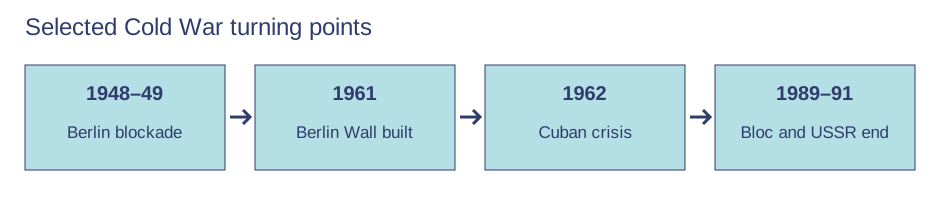
Use precise historical evidence to explain causes, consequences and changes. The 30 quick questions support recall and application; practise the broader written tasks in your PLC too.
Revise the key ideas
Alliance, ideology and growing tension, 1941–46
Grand Alliance — The USA, USSR and Britain cooperated against Nazi Germany despite earlier mistrust. The USA favoured capitalism and competitive democracy; the USSR had communist one-party rule. Shared wartime needs did not resolve disagreement about security, markets or the political future of Europe.
Tehran — At Tehran, Roosevelt, Churchill and Stalin discussed defeating Germany, including a Western invasion of France. Agreement on a second front helped cooperation. Stalin also sought post-war security through influence in Eastern Europe, while Britain and the USA had concerns about Soviet expansion.
Yalta — Yalta agreed plans for German occupation zones and Soviet entry into the war against Japan, with commitments concerning liberated Europe and Poland. Interpretations of free elections differed. Wartime cooperation therefore produced agreements whose application became disputed when Soviet power expanded.
Potsdam — At Potsdam, Truman replaced Roosevelt and Attlee replaced Churchill during the conference. Germany had surrendered, and Stalin's position in Eastern Europe was strong. Occupation and demilitarisation were agreed, but reparations, Poland and political control caused tension; Truman's atomic news added mistrust.
Atomic bomb — The USA used atomic bombs against Japan in August 1945 and briefly held a nuclear monopoly. Stalin saw potential intimidation and prioritised a Soviet weapon. The bomb changed military power and diplomacy, but ideological and security disagreements already existed.
Long telegram — George Kennan's Long Telegram advised Washington that Soviet leaders were hostile and would respond to firm resistance. It strengthened support for containment. It was an interpretation shaping policy, not neutral proof that every Soviet action had one motive.
Novikov telegram — Nikolai Novikov described the USA as seeking world dominance through economic and military power. Together with Kennan's report, this reinforced mutual suspicion. Each side interpreted the other's security measures as threatening expansion, making compromise harder.
Satellite states — Communist governments increasingly controlled Eastern European states, backed by Soviet military and political pressure. Stalin sought security against future attack; Western leaders saw broken promises and expansion. Churchill's 1946 Iron Curtain speech publicly expressed the emerging division.
Containment, blocs and Berlin, 1947–49
Truman Doctrine — Truman announced support for peoples resisting subjugation, initially linked to Greece and Turkey. It committed the USA more clearly to containment. Presenting the conflict as freedom against oppression widened the ideological divide and made Soviet leaders more suspicious of US involvement.
Marshall Plan — US aid helped European reconstruction, trade and stability, reducing conditions thought to encourage communism. The Soviet leadership rejected it and discouraged Eastern European participation, seeing economic dependence as a threat. Economic recovery and strategic influence were connected aims.
Cominform — Cominform linked communist parties and strengthened Soviet direction, responding to Western containment. It promoted ideological unity but could not erase every disagreement. Distinguish political coordination from Comecon's later economic role and from a military alliance.
Comecon — Comecon coordinated cooperation between communist economies and offered an alternative to Western-led recovery. It helped consolidate separate economic blocs. Soviet dominance restricted member independence; its role was not identical to NATO's collective military defence.
Berlin division — Germany and Berlin were each divided into occupation zones. West Berlin was an enclave deep within the Soviet zone. Western consolidation and currency reform in 1948 raised Soviet fears about a separate western Germany and made Berlin a focal point for disagreement.
Blockade and airlift — Stalin blocked key land access to West Berlin in June 1948. Western powers supplied it by air rather than withdrawing or fighting through the blockade. The blockade ended in May 1949; the successful airlift increased Western confidence and deepened division.
German states — The Federal Republic of Germany developed in western zones and the German Democratic Republic in the east. Separate governments institutionalised the split. Berlin remained a source of tension because its special occupation arrangements and divided population continued.
NATO — NATO committed members to collective defence against attack. It strengthened security for Western states and formalised US military involvement in Europe. The USSR saw it as hostile; the Warsaw Pact would later consolidate the opposing alliance.
Arms race and Hungary, 1949–58
Arms race — The USSR tested an atomic bomb in 1949; both sides developed more powerful hydrogen bombs and missile systems. Deterrence aimed to discourage attack through the threat of retaliation. Competition increased fear and expense and created risks of escalation or miscalculation.
Warsaw Pact — The Warsaw Pact brought the USSR and Eastern European allies into a Soviet-led military bloc. West Germany's NATO membership increased Soviet concern. Formal alliance supported Soviet influence, while member states had limited freedom to abandon the bloc.
Hungarian Uprising — Hungarian opposition grew amid dissatisfaction with repression and living conditions, encouraged by Khrushchev's criticism of Stalin. Imre Nagy introduced reforms and announced withdrawal from the Warsaw Pact. This threatened Soviet control beyond a change in local leadership.
Hungary crushed — Soviet forces crushed the uprising in November 1956 and Nagy was later executed. The USA and others condemned the action but avoided military intervention that risked wider war; the Suez crisis also distracted attention. The outcome exposed limits of liberation rhetoric and Soviet tolerance.
Berlin and Cuba, 1958–63
Refugee problem — Many East Germans, including skilled workers, escaped through Berlin. This harmed the economy and embarrassed communist leaders. Khrushchev's 1958 ultimatum demanded changes to Western access, using Berlin's occupation position to press for a settlement.
Summit difficulties — Geneva and Camp David talks produced little permanent change. The 1960 Paris summit collapsed after the U-2 spy-plane incident; the Vienna summit in 1961 increased tension between Khrushchev and Kennedy. Failed diplomacy helps explain why a physical barrier became attractive to eastern leaders.
Berlin Wall — East German authorities, supported by the USSR, sealed the border and built the Wall. It reduced emigration but exposed the coercion needed to retain people. Western leaders protested while generally accepting a barrier rather than risking war to remove it.
Wall consequences — The Wall reduced a recurring refugee crisis and confrontation continued without open war. Families were divided and escape became dangerous. Kennedy's 1963 visit reaffirmed support for West Berlin; evaluate both the propaganda impact and the reduction of one immediate source of instability.
Cuban Revolution — Castro overthrew Batista; nationalisation and deteriorating relations with the USA encouraged closer Soviet links. US refusal to recognise the new government and economic pressure increased Cuban insecurity. Cuba's position near the USA gave the developing alliance strategic significance.
Bay of Pigs — A US-backed force of Cuban exiles attempted to overthrow Castro in April 1961 and failed. Kennedy suffered embarrassment, while Castro sought stronger protection. The episode increased the likelihood that Cuba would accept Soviet military support.
Missile motives — Khrushchev placed nuclear missiles in Cuba to defend an ally and counter US strategic advantages, including missiles near the USSR. Kennedy considered them an unacceptable threat. Motives included security and prestige, rather than only a desire to start nuclear war.
Crisis sequence — US photographs revealed missile sites in October 1962. Kennedy announced a naval quarantine; tense exchanges followed while both sides considered military options. Negotiations produced Soviet withdrawal in return for a US promise not to invade Cuba and a privately agreed removal of US missiles from Turkey.
Crisis consequences — Both sides could claim success but recognised the danger of escalation. A direct communications link, the hotline, was established in 1963 to reduce delay in emergencies. Castro resented exclusion from negotiations; the agreement did not end the Cold War or the arms race.
Prague and arms control, 1963–70
Limited Test Ban — The treaty prohibited nuclear tests in the atmosphere, space and underwater, while underground tests remained allowed. It reduced radioactive fallout and signalled cooperation after Cuba. It neither abolished existing weapons nor ended all testing.
Other treaties — The Outer Space Treaty restricted weapons of mass destruction in space. The Nuclear Non-Proliferation Treaty sought to limit spread of nuclear weapons and support peaceful uses and disarmament efforts. Arms control can manage danger without removing rivalry or unequal arsenals.
Prague Spring — Alexander Dubček promoted reforms in Czechoslovakia including greater freedom of expression and reduced censorship. He sought socialism with a human face rather than simply joining the Western bloc. Soviet leaders feared reform could spread and weaken their control.
Invasion and doctrine — Warsaw Pact forces invaded Czechoslovakia in August 1968 and ended the reforms. The Brezhnev Doctrine justified intervention when socialism was judged threatened. It signalled that Eastern European governments could not freely determine their political direction.
Prague reactions — Western governments condemned the invasion but avoided military action; some communist parties also criticised it. Soviet control survived, while trust and the appeal of communism suffered. Compare with Hungary: both showed limits to reform and Western willingness to intervene.
Détente and renewed hostility, 1970–85
Détente — In the 1970s both powers sought lower tensions because nuclear confrontation was dangerous and expensive. Diplomatic agreements coexisted with ideological competition and proxy conflicts. Détente describes relaxation, not friendship or complete disarmament.
SALT I — SALT I included limits on certain strategic launchers and the Anti-Ballistic Missile Treaty. It recognised a need to restrain competition. It did not cover every weapon or eliminate the ability to develop multiple warheads, so limits and loopholes mattered.
Helsinki — The Helsinki Accords addressed security, cooperation and human rights. Recognition of existing European borders benefited the USSR, while rights commitments offered critics a standard against which to judge regimes. Agreements could have consequences beyond leaders' immediate intentions.
SALT II — SALT II sought further strategic limits but was not ratified by the US Senate after relations worsened, especially over Afghanistan. Distinguish signing from formal ratification. The failure showed that arms-control progress depended on the wider political climate.
Afghanistan — Soviet intervention supported a friendly regime and sought to protect regional interests, but the USA saw expansion and a threat near important oil routes. The invasion renewed hostility and contributed to sanctions and the failure to ratify SALT II; its causes were more than a single personal decision.
Carter Doctrine — Carter declared that outside attempts to control the Persian Gulf threatened vital US interests. The USA led a boycott of the 1980 Moscow Olympics; the USSR and allies boycotted Los Angeles in 1984. Sporting boycotts made superpower conflict visible without direct military war.
Reagan and SDI — Reagan increased military spending and used strongly anti-Soviet language. The Strategic Defence Initiative announced in 1983 proposed technology to defend against missile attacks. Soviet leaders feared losing deterrence and facing costs they could not match; the proposed system was not a fully operational shield.
Gorbachev and the end, 1985–91
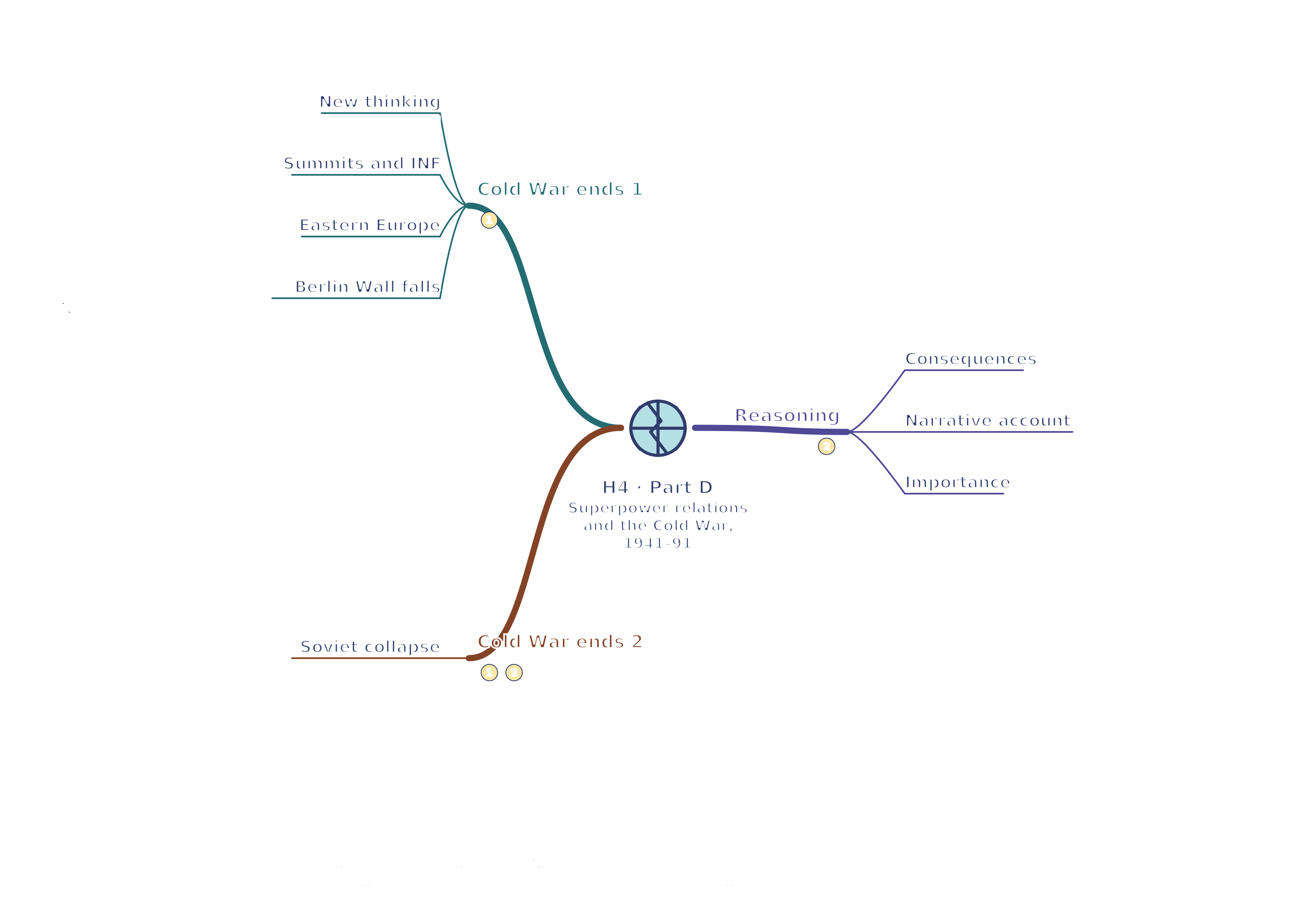
New thinking — Gorbachev became Soviet leader in 1985 and promoted perestroika, economic restructuring, and glasnost, greater openness. Economic weakness and military costs encouraged cooperation. Reform was intended to strengthen socialism, not initially to dissolve the Soviet Union.
Summits and INF — Meetings at Geneva and Reykjavik exposed disagreements but developed dialogue. The 1987 INF Treaty eliminated an entire class of intermediate-range nuclear missiles. Negotiation combined leadership, public pressure and economic constraints; neither leader alone explains the reduction of tensions.
Eastern Europe — Gorbachev moved away from enforcing communist rule by military intervention. Protests, national movements and reforming governments challenged Eastern European regimes in 1989. Local people and leaders mattered: withdrawal of Soviet backing enabled change but did not automatically cause identical outcomes everywhere.
Berlin Wall falls — Protests and emigration weakened East Germany, and a confused announcement of travel rules prompted crowds to border crossings on 9 November 1989. Guards opened crossings. The fall of the Wall symbolised collapsing control; German reunification followed in 1990 rather than occurring that same night.
Soviet collapse — A failed hard-line coup in August 1991 weakened Gorbachev and strengthened opponents including Boris Yeltsin. Republics asserted independence and the USSR dissolved in December. The Warsaw Pact had dissolved earlier in 1991 as the bloc broke up; do not reverse that chronology.Selected overview. Explain the qualifications using the notes.
Period-study reasoning
Consequences — A consequence of the Berlin blockade was stronger Western cooperation, illustrated by consolidation of western Germany and NATO. Explain why the event produced the outcome; do not simply recount the original event. Two consequences should be genuinely distinct rather than the same point reworded.
Narrative account — For Cuba, connect the revolution and Bay of Pigs to Soviet protection, missile discovery, quarantine and the negotiated settlement. A narrative explains how developments led to one another. Dates provide order but cannot replace causal connections.
Importance — For Helsinki's importance to Soviet control, connect rights commitments to later criticism and opposition, alongside recognition of borders. Relevance depends on the specified development. A description of an agreement without showing its effect does not establish importance.
Test yourself
30 questions · Random sets of 10. These quick checks support revision; practise longer explanations and justified judgements too.
Mind map
Use the branches to recall the ideas and explain their connections. Check the revision notes for the full detail.
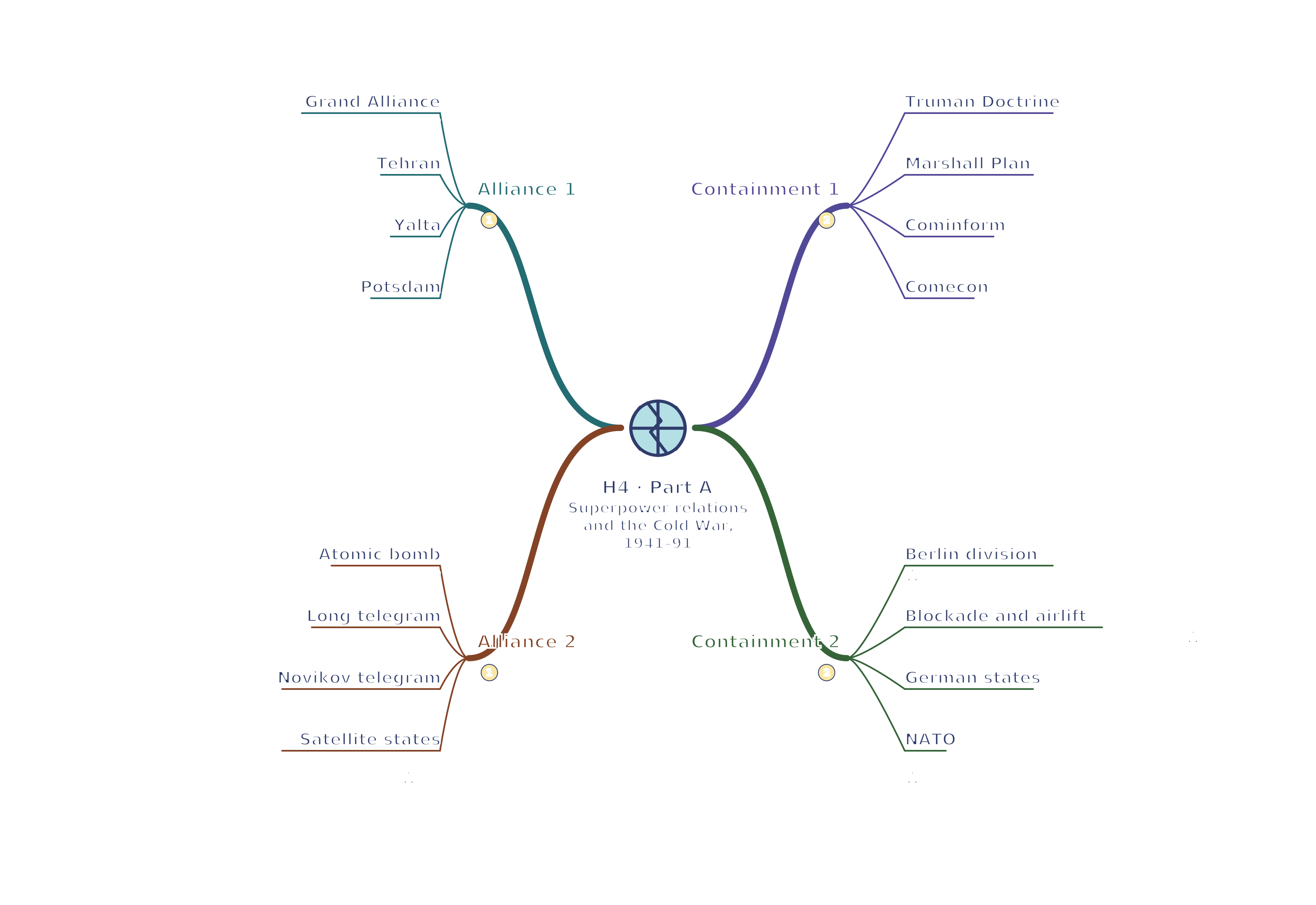
View H4 · Alliance 1 / Alliance 2 / Containment 1 / Containment 2 mind mapOpen the full-size map to zoom. Download the PDF to print on A4 or enlarge to A3.
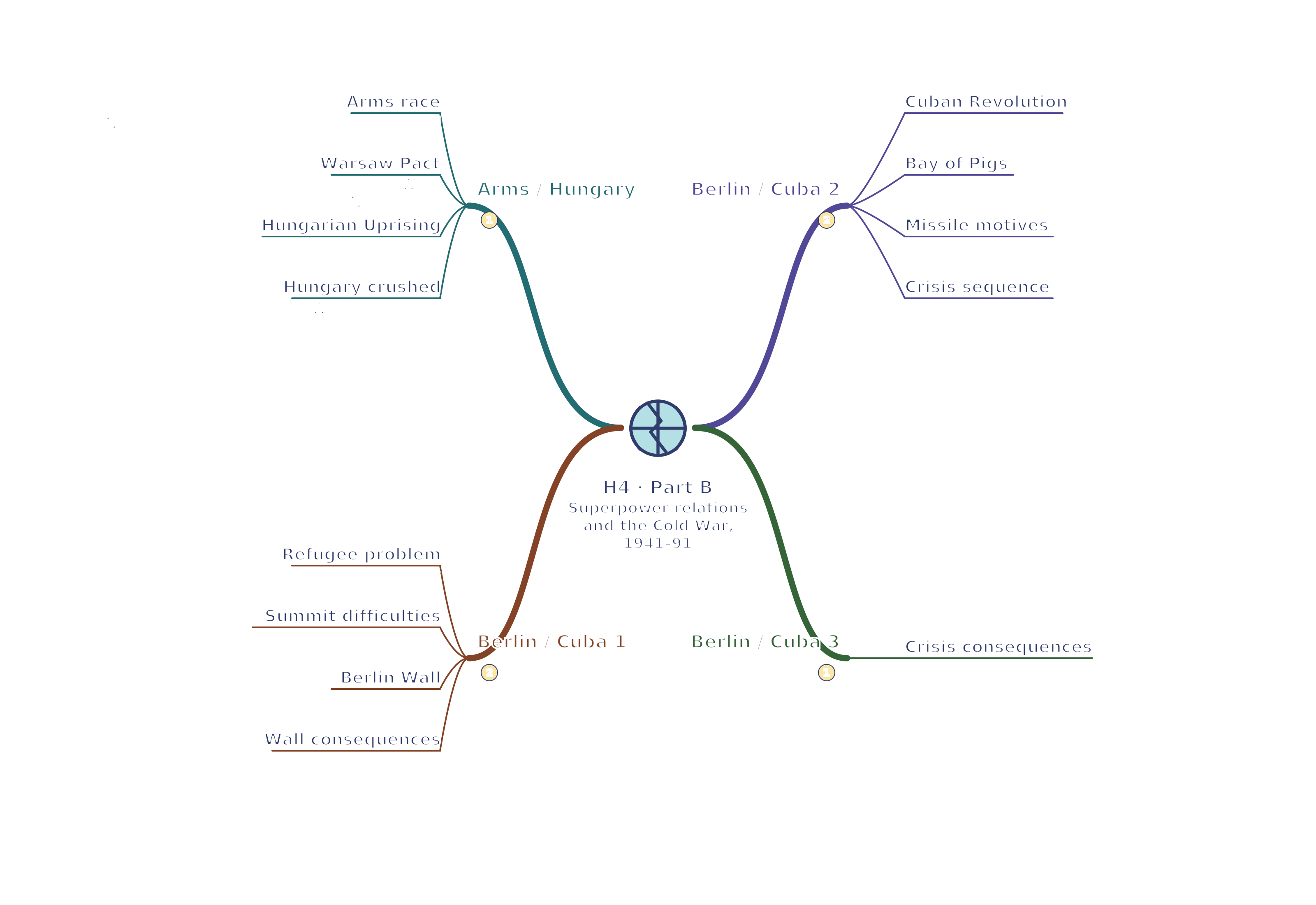
H4 · Arms / Hungary / Berlin / Cuba 1 / Berlin / Cuba 2 / Berlin / Cuba 3
View H4 · Arms / Hungary / Berlin / Cuba 1 / Berlin / Cuba 2 / Berlin / Cuba 3 mind mapOpen the full-size map to zoom. Download the PDF to print on A4 or enlarge to A3.
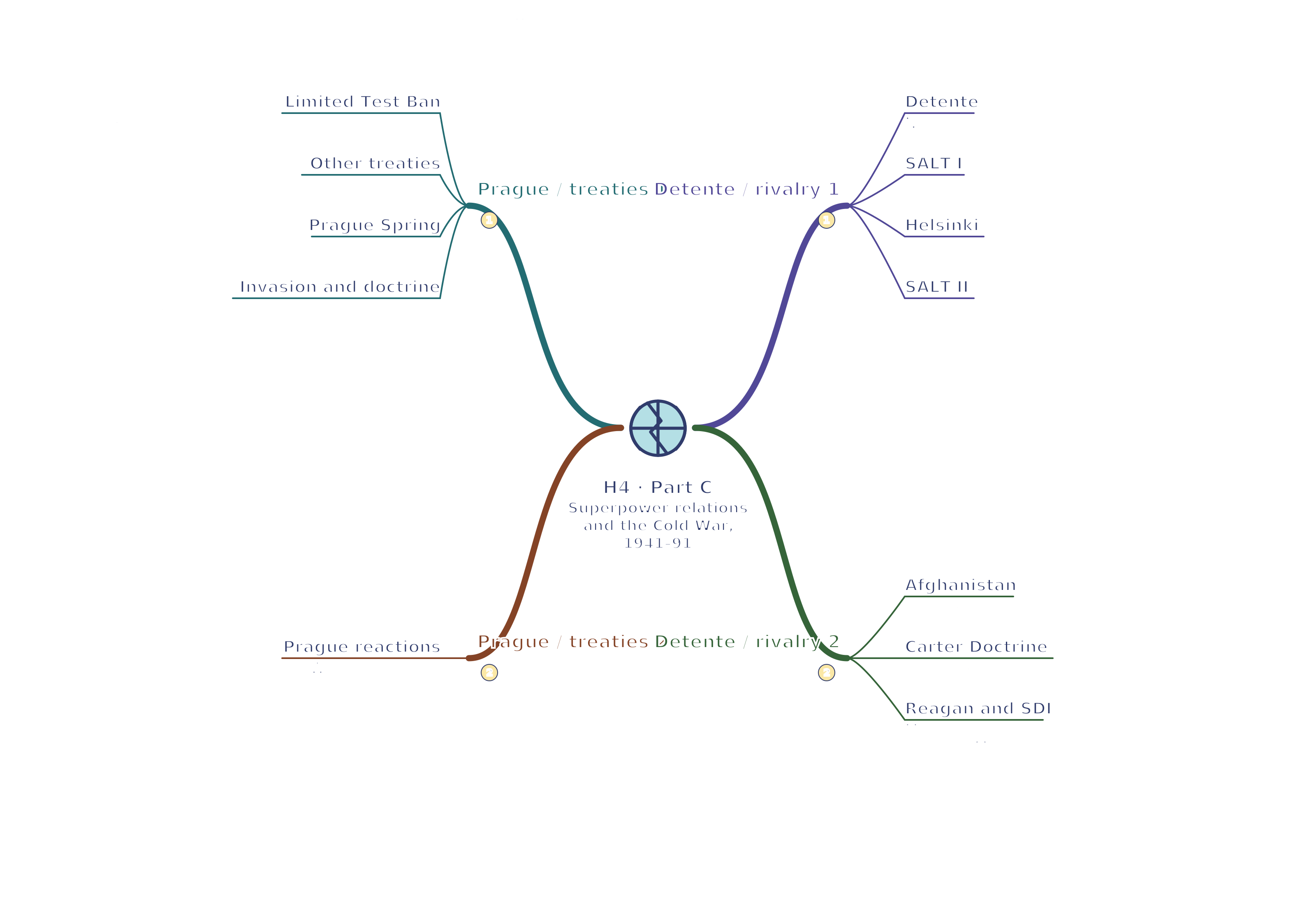
View H4 · Prague / treaties 1 / Prague / treaties 2 / Détente / rivalry 1 / Détente / rivalry 2 mind mapOpen the full-size map to zoom. Download the PDF to print on A4 or enlarge to A3.
Grand Alliance: 1941 common enemy united ideologically different powers
Tehran: 1943: second front agreed; Soviet security remained important
Yalta: February 1945: occupation plans and elections raised future disputes
Potsdam: July–August 1945: new leaders and atomic power sharpened tension
Alliance 2
Atomic bomb: US monopoly strengthened leverage and Soviet suspicion
Long telegram: 1946: Kennan portrayed Soviet policy as expansionist
Novikov telegram: 1946: Soviet report portrayed US ambition as domination
Satellite states: Soviet control created a buffer and alarmed the West
Containment 1
Truman Doctrine: 1947: support for states resisting communist pressure
Marshall Plan: 1947 economic aid aimed at recovery and containment
Cominform: 1947 organisation coordinated communist political action
Comecon: 1949 economic organisation reinforced the Eastern bloc
Containment 2
Berlin division: Western zones lay within Soviet-occupied eastern Germany
Blockade and airlift: 1948–49: Soviet land blockade met Western air supply
German states: 1949: FRG and GDR made division more permanent
NATO: 1949 collective defence tied the USA to Western Europe
Arms / Hungary
Arms race: Nuclear competition raised deterrence and destruction risks
Warsaw Pact: 1955 Eastern military alliance followed West German NATO entry
Hungarian Uprising: 1956: reform demands escalated towards leaving the bloc
Hungary crushed: Soviet invasion restored control; Western aid was limited
Berlin / Cuba 1
Refugee problem: Leaving through Berlin weakened East Germany
Summit difficulties: 1959–61 talks failed to resolve Berlin's status
Berlin Wall: August 1961: barrier stopped movement and separated families
Wall consequences: Stabilised the border while symbolising repression
Berlin / Cuba 2
Cuban Revolution: 1959: Castro's rule moved from US hostility towards Soviet ties
Bay of Pigs: 1961 failed invasion strengthened Castro and Soviet alignment
Missile motives: 1962: Soviet missiles protected Cuba and altered strategic balance
Crisis sequence: Discovery led to quarantine, negotiation and withdrawal
Berlin / Cuba 3
Crisis consequences: Hotline and restraint followed a near-war confrontation
Prague / treaties 1
Limited Test Ban: 1963 restricted tests, not all nuclear weapons
Other treaties: 1967 space and 1968 non-proliferation limits widened cooperation
Prague Spring: 1968: Dubček sought reform within socialism
Invasion and doctrine: 1968 Soviet-led intervention limited allies' sovereignty
Prague / treaties 2
Prague reactions: Condemnation did not produce Western military intervention
Détente / rivalry 1
Détente: Negotiation managed costs and danger without ending rivalry
SALT I: 1972 limited selected missiles and anti-ballistic defences
Helsinki: 1975 linked European borders, cooperation and human rights
SALT II: 1979 signed limits were undermined by deteriorating relations
Détente / rivalry 2
Afghanistan: 1979 Soviet invasion helped end détente
Carter Doctrine: 1980 US warning and Olympic boycott raised confrontation
Reagan and SDI: Military pressure and proposed missile defence alarmed Moscow
Cold War ends 1
New thinking: Economic strain encouraged reform and negotiated security
Summits and INF: Reagan and Gorbachev negotiated despite disagreements
Eastern Europe: Reduced threat of Soviet force let local movements act
Berlin Wall falls: November 1989 border opening symbolised bloc collapse
Cold War ends 2
Soviet collapse: 1991: failed coup and national claims ended the USSR
Reasoning
Consequences: Explain a resulting change with evidence and a causal link
Narrative account: Select a linked sequence with causes, events and outcomes
Importance: Explain significance for the relationship named in the question
Connections
Alliance 1 → Alliance 2: Unresolved wartime agreements deepened suspicion after leadership and military changes.
Containment 1 → Containment 2: Containment and divided occupation developed into rival institutions and states.
Part connections
H4 · Alliance 1 / Alliance 2 / Containment 1 / Containment 2: Alliance 1 → Alliance 2 — Unresolved wartime agreements deepened suspicion after leadership and military changes.
H4 · Alliance 1 / Alliance 2 / Containment 1 / Containment 2: Containment 1 → Containment 2 — Containment and divided occupation developed into rival institutions and states.
H4 · Arms / Hungary / Berlin / Cuba 1 / Berlin / Cuba 2 / Berlin / Cuba 3: Arms / Hungary → Berlin / Cuba 3 — Nuclear deterrence made a Cuban confrontation dangerous and compromise urgent.
H4 · Arms / Hungary / Berlin / Cuba 1 / Berlin / Cuba 2 / Berlin / Cuba 3: Berlin / Cuba 1 → Berlin / Cuba 2 — Failed Berlin diplomacy and Cuban invasion strengthened calls for defensive barriers.
H4 · Cold War ends 1 / Cold War ends 2 / Reasoning: Cold War ends 1 → Cold War ends 2 — New thinking reduced force, allowing local movements to challenge bloc control.
H4 · Cold War ends 1 / Cold War ends 2 / Reasoning: Cold War ends 2 → Reasoning — A narrative must distinguish the Wall’s opening from the later Soviet collapse.
 Mr Kidman's Classroom