Use concepts, evidence and competing explanations to investigate society. The 30 quick questions support recall and application; practise the broader written tasks in your PLC too.
Revise the key ideas
Constructing crime and deviance
Crime and deviance — Crime breaks criminal law; deviance breaks social norms. An action may be both, either or neither depending on context. Rudeness can be deviant without criminality. Legal change and cultural variation show that these categories are socially defined; this does not deny victims' harm or make every action equally acceptable.
Social construction — An act may be criminal in one period and lawful in another, while norm violations depend on situation and audience. Investigate who creates rules and whose conduct attracts sanctions. Explaining social construction is different from saying nothing really happens or that sociologists approve of harmful behaviour.
Merton's strain theory — Merton's work on American society linked cultural pressure for material success to uneven access to accepted routes. Strain can encourage alternative responses. His functionalist account explains structural pressure rather than claiming poverty automatically produces crime. Anomie concerns weakened or disrupted norms governing pursuit of goals.
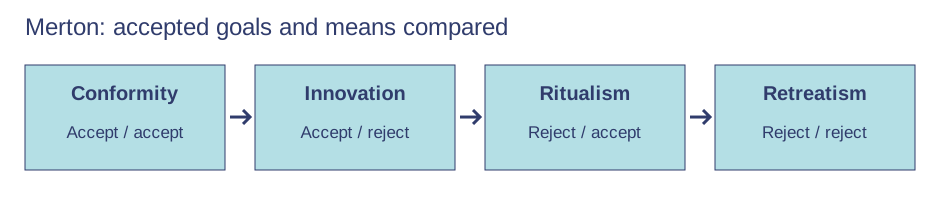
Merton's adaptations — Conformity accepts conventional goals and means; innovation pursues goals through rejected means; ritualism follows means while abandoning success goals; retreatism abandons both; rebellion replaces both. A fictional person pursuing wealth by fraud illustrates innovation. These analytical categories do not label every person in a class as criminal.Selected overview. Explain the qualifications using the notes.
Evaluating Merton — The theory explains pressure and variation in responses, yet a consensus about goals cannot be assumed. It can underplay powerful groups' lawmaking and white-collar crime, and cannot alone explain why similarly constrained people act differently. Compare structural pressure with interaction, gendered control and subcultural belonging.
Becker's labelling account — Outsiders (1963) argued that deviance involves others applying rules and labels. Selective enforcement can make similar conduct attract different responses. A label can become a master status that overshadows other identities, leading to exclusion and changes in self-understanding. This is a possible process, not inevitable acceptance of every label.
Deviant career — After labelling, reduced legitimate opportunities can push someone towards a group that supports a deviant identity. Explain the sequence from reaction to changed opportunities and meanings. Critics note that labelling may explain subsequent conduct better than the initial act, and people can resist labels or leave such groups.
Structural and subcultural accounts — Marxists examine ownership, law and unequal enforcement; subcultural theories examine group norms and status; interactionists examine meanings and reactions. Feminists add gendered opportunities and controls. Compare each on the same behaviour and consider what it explains or omits rather than using a theory name as an explanation.
Social control and gender
Formal control — Police, courts and prisons exercise formal social control. Rules and punishments can deter, incapacitate or respond to harm. Their use is also shaped by resources and priorities. Functionalists stress order, while conflict perspectives ask whose interests define laws and whether enforcement is equal.
Informal control — Families, friends, neighbours and peers use praise, criticism, ridicule or exclusion. Unwritten rules can shape behaviour even without police action. Sanctions may promote cooperation or enforce unequal expectations; ask who applies them and whether people recognise their legitimacy.
Heidensohn's home control — Women and Crime (1985) used a feminist control account to explain comparatively lower female offending. Domestic obligations, financial dependence and threats of violence can restrict movement and time. This attributes constraints to social arrangements, not natural female conformity; experiences vary and controlling violence is harmful.
Heidensohn's public and workplace control — In public, threats of violence and reputational judgement can limit movement; at work, male-dominated authority and harassment can constrain women. Different controls can reinforce one another. Critics question generalisation and the evidence behind some claims, and highlight women who resist or have different opportunities.
Perspectives on control — Functionalists stress rules enabling collective life. Marxists examine protection of property and class interests; feminists examine patriarchal constraints; interactionists examine negotiation and selective reactions. A sanction can maintain order and distribute power unequally, so evaluate its operation and effects rather than giving one universal purpose.
Explaining behaviour and social patterns
Cohen's status frustration — Delinquent Boys (1955) argued that some working-class boys face failure measured against middle-class standards and seek status through a delinquent subculture. Group approval can reward vandalism or defiance. This explains some non-utilitarian conduct beyond financial gain, but assumes shared initial goals and does not represent all working-class boys.
Evaluating subculture — A group can offer prestige, identity and protection; not all subcultures are criminal. Cohen's focus is historically specific and male-centred. Some youths may reject dominant standards from the outset rather than fail to meet accepted goals. Compare evidence on group meanings with wider opportunities and individual responses.
Carlen's class deal — Women, Crime and Poverty (1988) used in-depth interviews with 39 convicted women, mainly working class. A class deal promises a reasonable living through respectable work. When employment, poverty and exclusion undermine that reward, some women may judge crime more attractive. It is an explanation of accounts from a selected sample, not a rule about all poor women.
Carlen's gender deal — The gender deal promises material and emotional support in return for conformity to a domestic role. Disappointed rewards, abuse or exclusion can weaken commitment to conventional arrangements. Carlen linked choices to social conditions and control. Small qualitative samples reveal experiences but cannot establish prevalence or represent women who did not offend.
Class and crime — Deprivation may restrict legitimate routes, while affluent occupations provide access to fraud or corporate offences. White-collar crime concerns wrongdoing in occupational settings; corporate crime benefits an organisation. Compare actual offending, reporting and detection. Recorded working-class overrepresentation cannot alone show that poorer people are naturally more criminal.
Gender and crime — Gendered roles and peer expectations can affect exposure to offending and criminal justice. The chivalry thesis proposes more lenient treatment of women; critics note unequal treatment by offence and conformity to gender expectations. Double standards may intensify judgement. Do not treat one mechanism as established for every stage or group.
Ethnicity and crime — Socio-economic inequality, discrimination, police deployment and reporting can affect recorded patterns. Ethnicity or socially constructed race is not an innate cause of criminality. Compare stop, arrest, conviction and victimisation data: each measures a different stage. Group averages conceal differences in age, area and circumstances.
Age and crime — Peer status, transitions, supervision and access to particular offences change with age. Young people may attract more visible street policing, while occupational offences require positions adults hold. An age pattern needs an offence, measure and time period; it cannot establish that every young person offends or that older people do not.
Public debates and responses
Violence and risk — Compare reports of violence with victimisation, recording practices and definitions. News values favour dramatic, unusual incidents and can distort perceptions of frequency. Different measures can legitimately show different patterns. Analyse harm and prevention using evidence without dismissing victims or treating a headline as a population estimate.
Sentencing purposes — Retribution concerns deserved punishment; deterrence aims to discourage offending; incapacitation restricts opportunities; rehabilitation seeks change. A sentence may serve more than one purpose. Evaluate evidence about reoffending, proportionality, victim needs and unequal effects rather than assuming severity automatically prevents crime.
Young offenders — Custody, community responses and diversion can affect education, stigma and later chances. Labelling theory predicts some harmful exclusion; other arguments stress protection and responsibility. Evaluate a specified policy and outcome. Young people and offences are diverse; no single intervention can be assumed effective in every situation.
Prisons and alternatives — Prisons remove liberty and can protect the public, but overcrowding, disrupted relationships and limited support may obstruct rehabilitation. Community sanctions may preserve work and ties while creating supervision demands. Compare cost, safety, reoffending and access to support, using comparable groups rather than raw rates alone.
Media and moral panic — A moral panic is disproportionate concern about a supposed threat to social values. Media framing and reactions may amplify labels and fear, sometimes strengthening deviance. Distinguish Albert Cohen's subculture theory from Stanley Cohen's moral-panic work. A concept is an interpretation to test against evidence, not proof that all public concerns are unjustified.
Crime data and research
Recorded crime — Police records depend on reporting, recording rules, investigative priorities and law. An increase may reflect more reporting or improved recording rather than more underlying incidents. Records are useful for studying workload and detected patterns, but cannot cover every offence or measure all victim experiences.
Dark figure — People may not report because of fear, stigma, low trust, uncertainty or belief that action is unlikely. Some crimes lack an obvious individual victim. The dark figure is not directly observable as an exact total; surveys and other sources provide estimates with their own exclusions.
Victim surveys — Surveys ask sampled people about victimisation, helping reveal unreported offences. Recall, willingness to disclose, age coverage and excluded populations affect validity. A household survey will not measure all business crimes or offences without identifiable victims. Check scope before comparing it with police records.
Self-report studies — Respondents report their own conduct, often using anonymous questionnaires. They may exaggerate, forget or conceal acts; a school sample excludes those not attending. These studies can challenge stereotypes but do not establish an exact population total without suitable sampling and credible answers.
Patterns and trends — Counts show recorded numbers; rates relate them to a population. A town's count can rise with population while its rate is unchanged. Different offences and measures can move in different directions. State period, scope and denominator, and distinguish a percentage change from a change in percentage points.
Triangulating evidence — Police records, surveys, interviews and observation can provide complementary views. Agreement can strengthen a finding; disagreement prompts investigation of definitions, coverage and process. Do not average incompatible series or assume official sources are either perfect or worthless. Research with victims or offenders needs privacy, safety and careful consent.
Dated crime evidence
Different offence trends — ONS's July 2025 release estimated 4.2 million fraud incidents in the CSEW year ending March 2025, 31% above the preceding survey year. Criminal damage was estimated at 608,000 incidents, with no statistically significant year-on-year change, but 82% below the 1995 peak. These dated England-and-Wales estimates show why crime is not one uniform trend. ONS statistical release.
Statistical uncertainty — Survey estimates have sampling uncertainty. ONS describes whether changes are statistically significant; a small observed difference may plausibly arise through sampling. Frauds in this series are comparable only from the period their survey collection began. Do not treat differing measures or pandemic-related breaks as uninterrupted equivalent observations. ONS statistical release.
Further criminal-justice and media concepts
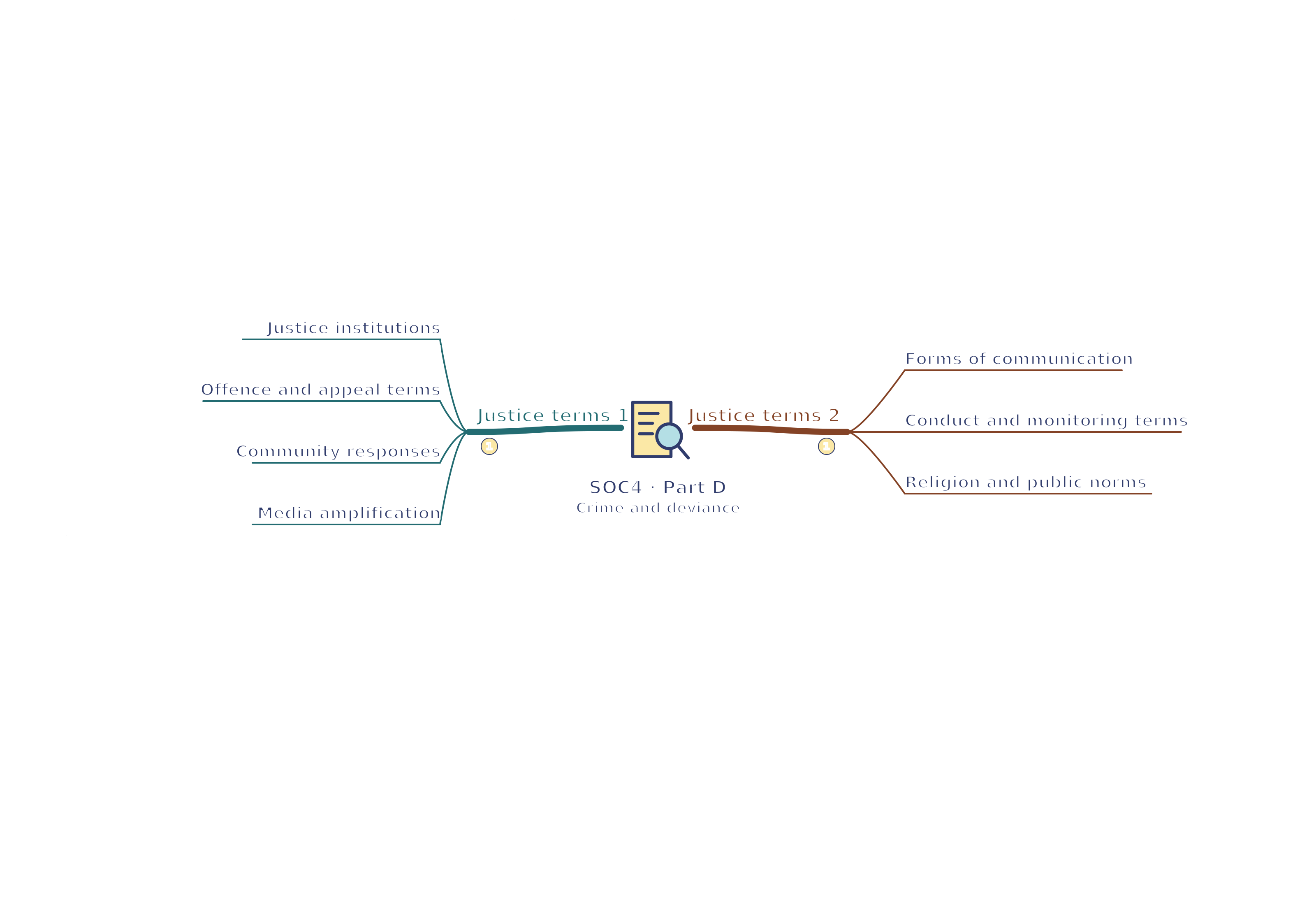
Justice institutions — The legislature makes laws through a legislative process; legislation is enacted law. The judiciary comprises judges and courts interpreting and applying law. Magistrates deal with specified matters in lower courts. The criminal justice system includes police, prosecution, courts and corrections; its stages produce different kinds of data.
Offence and appeal terms — An indictable offence can be tried on indictment in a higher criminal court; summary or non-indictable offences are tried through lower-court procedures in the relevant jurisdiction. A right of appeal provides a route to challenge a decision. A miscarriage of justice is a serious wrongful legal outcome, such as a wrongful conviction. These are concepts, not personal legal guidance.
Community responses — Community service involves required unpaid work as a sanction; probation concerns supervised community management and support. A police caution is a formal warning used under specified arrangements. Such responses differ from a conviction or custodial sentence. Evaluate effects on reoffending, stigma, safety and opportunity rather than assuming one outcome from a label.
Media amplification — Agenda setting influences which issues receive attention; gatekeepers decide what is published. Folk devils are people or groups portrayed as symbolic threats; a scapegoat is blamed disproportionately for problems. Deviancy amplification can occur when reactions and exclusion reinforce conduct. Media stereotypes may be part of this process rather than representative evidence.
Forms of communication — Popular press is commonly associated with mass-market presentation; quality press with more extensive public-affairs coverage. These broad labels do not guarantee accuracy. Propaganda deliberately promotes a cause or viewpoint; censorship restricts expression. Evaluate content, purpose, selection and evidence in the particular text.
Conduct and monitoring terms — Delinquency commonly describes youth offending or norm violation. Anti-social behaviour can cause distress or nuisance; not every instance is a recorded crime. Surveillance monitors activities. Identity theft misuses another person's identifying information; terrorism uses or threatens violence for specified political or ideological purposes. Legal and social definitions differ by setting and should not be inferred from a stereotype.
Religion and public norms — Organised religion involves institutions and shared practices. An established church has a formal relationship with the state. Fundamentalism seeks adherence to beliefs presented as foundational and authoritative. These concepts do not mean every religious person has the same political view or that religion is intrinsically criminal or deviant.
Test yourself
30 questions · Random sets of 10. These quick checks support revision; practise longer explanations and justified judgements too.
Mind map
Use the branches to recall the ideas and explain their connections. Check the revision notes for the full detail.
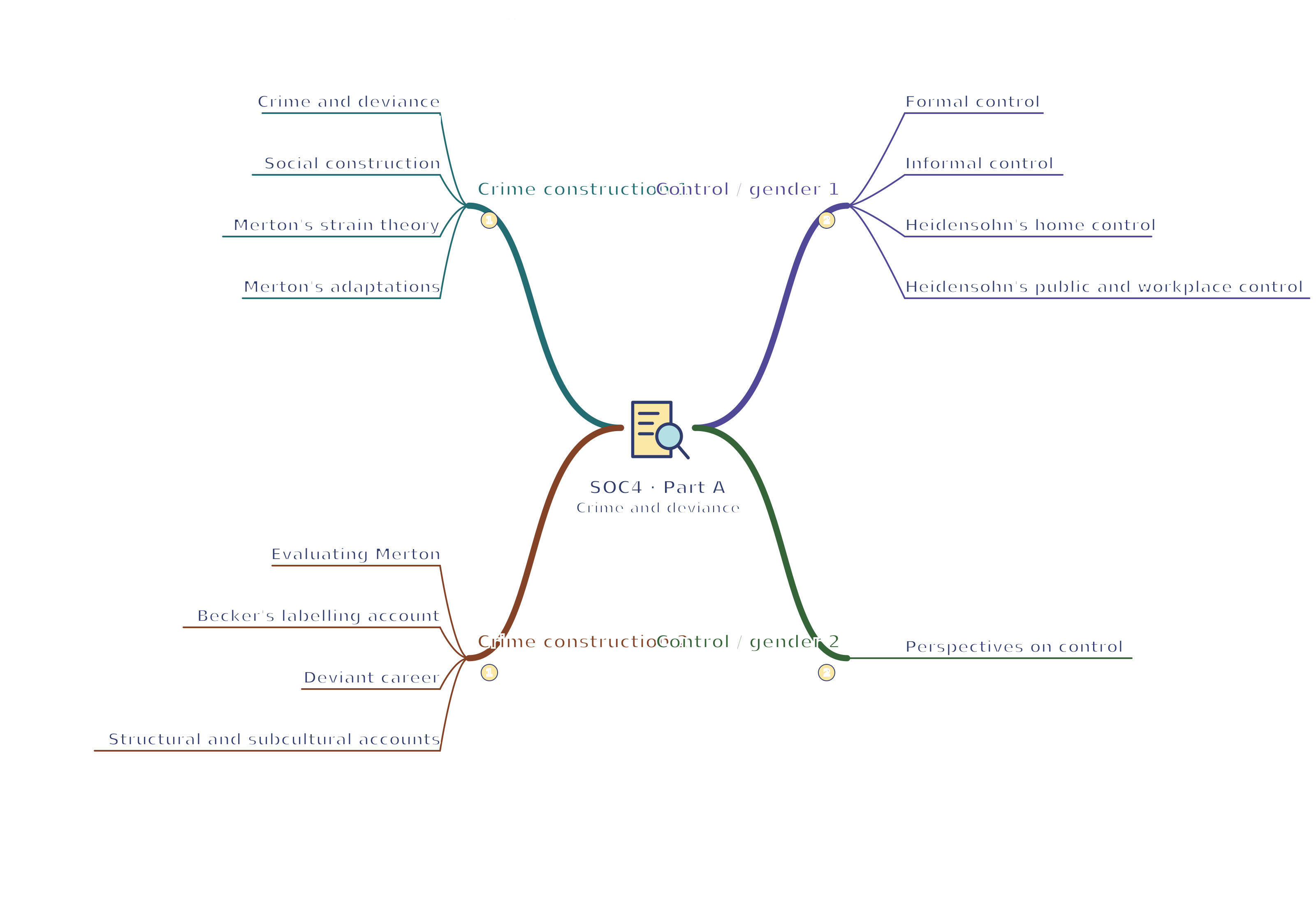
SOC4 · Crime construction 1 / Crime construction 2 / Control / gender 1 / Control / gender 2
View SOC4 · Crime construction 1 / Crime construction 2 / Control / gender 1 / Control / gender 2 mind mapOpen the full-size map to zoom. Download the PDF to print on A4 or enlarge to A3.
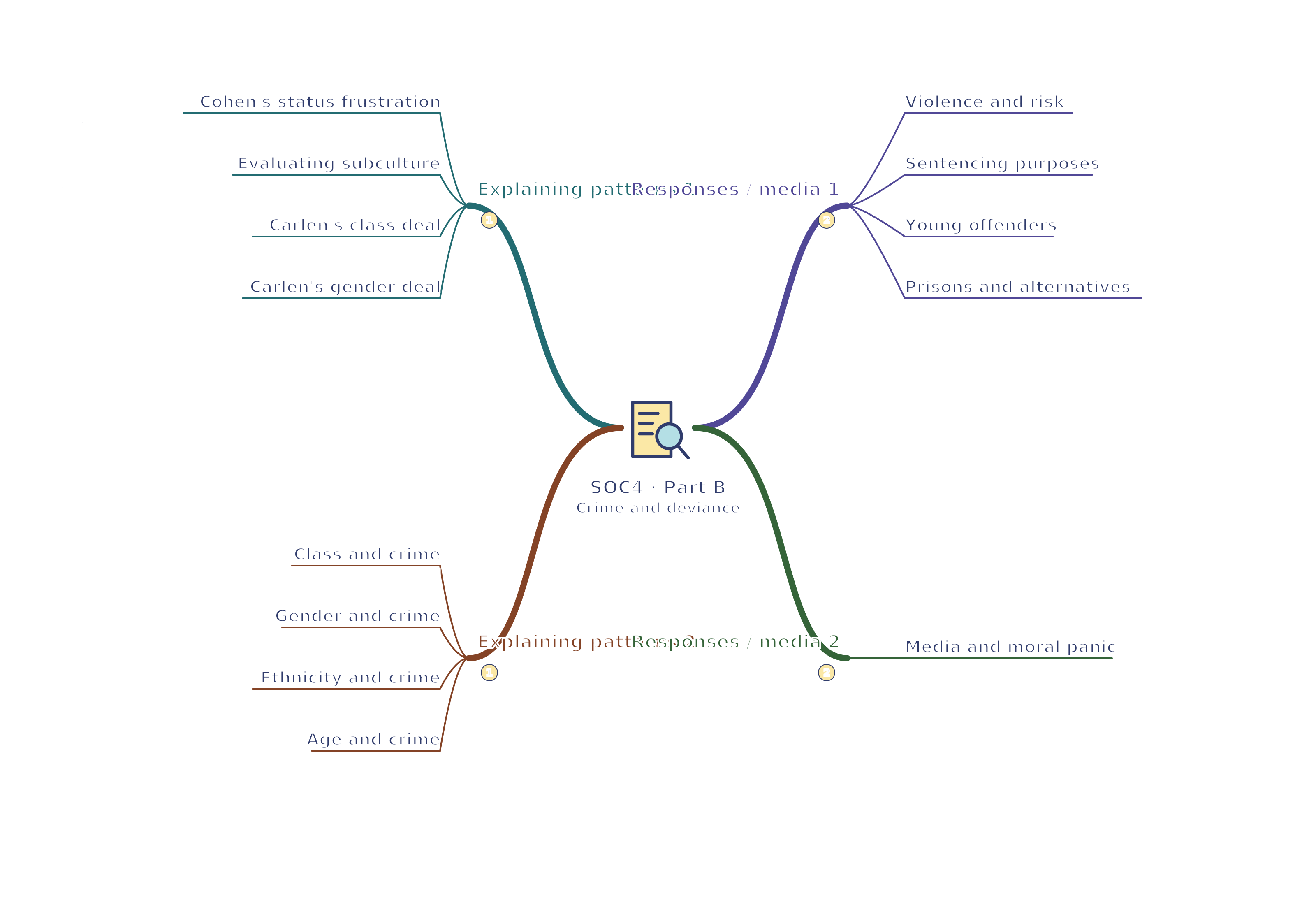
SOC4 · Explaining patterns 1 / Explaining patterns 2 / Responses / media 1 / Responses / media 2
View SOC4 · Explaining patterns 1 / Explaining patterns 2 / Responses / media 1 / Responses / media 2 mind mapOpen the full-size map to zoom. Download the PDF to print on A4 or enlarge to A3.
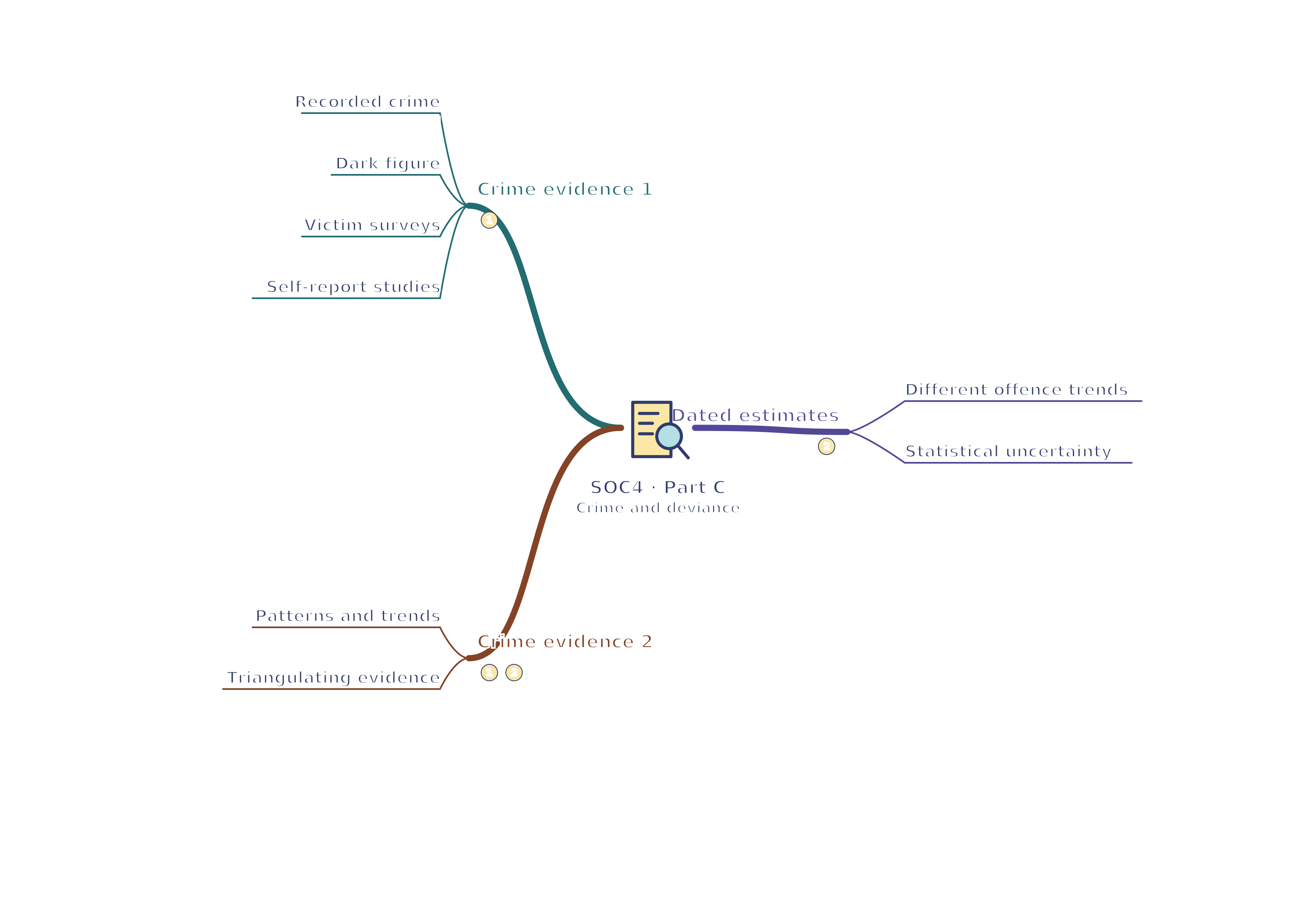
View SOC4 · Crime evidence 1 / Crime evidence 2 / Dated estimates mind mapOpen the full-size map to zoom. Download the PDF to print on A4 or enlarge to A3.
Crime and deviance: Legal prohibition differs from violation of social expectations
Social construction: Definitions and enforcement vary with time, place and power
Merton's strain theory: Shared success goals can conflict with unequal legitimate opportunities
Merton's adaptations: Acceptance of goals and means produces different responses
Crime construction 2
Evaluating Merton: Opportunity matters but not everyone responds alike
Becker's labelling account: Rule-making and reactions influence who is defined as deviant
Deviant career: Exclusion can reinforce identity and group involvement
Structural and subcultural accounts: Resources and group values offer different mechanisms
Control / gender 1
Formal control: Authorised institutions apply official rules and sanctions
Informal control: Everyday approval and disapproval can regulate conduct
Heidensohn's home control: Domestic duties and patriarchal power can constrain women's opportunities
Heidensohn's public and workplace control: Reputation, fear and hierarchies can restrict behaviour
Control / gender 2
Perspectives on control: Order and domination are competing interpretations
Explaining patterns 1
Cohen's status frustration: Blocked recognition can encourage alternative group standards
Evaluating subculture: Belonging and rewards matter without explaining all crime
Carlen's class deal: Conventional paid work was expected to provide material rewards
Carlen's gender deal: Domestic labour was expected to bring security and belonging
Explaining patterns 2
Class and crime: Opportunity and enforcement affect observed patterns
Gender and crime: Patterns reflect opportunities, socialisation, control and recording
Ethnicity and crime: Disadvantage and criminal-justice processes need separate analysis
Age and crime: Life stage and opportunity can affect offending and detection
Responses / media 1
Violence and risk: Public concern may diverge from measured prevalence
Sentencing purposes: Deterrence, protection, rehabilitation and punishment can conflict
Young offenders: Responses balance accountability, welfare and future opportunities
Prisons and alternatives: Institutional conditions influence outcomes beyond the sentence length
Responses / media 2
Media and moral panic: Amplification can turn a group into a symbolic threat
Crime evidence 1
Recorded crime: Administrative figures measure offences known and recorded
Dark figure: Unreported and unrecorded offences remain outside police counts
Victim surveys: Experiences can be measured beyond police reports
Self-report studies: Anonymous disclosure can reveal otherwise hidden offending
Crime evidence 2
Patterns and trends: Counts, rates and composition answer different questions
Triangulating evidence: Compare sources whose strengths and limits differ
Dated estimates
Different offence trends: 2025 fraud rose while criminal damage was far below its 1995 peak
Statistical uncertainty: A measured difference may not establish a real population change
Justice terms 1
Justice institutions: Law-making bodies differ from bodies interpreting and applying law
Offence and appeal terms: Procedural categories and outcomes require context
Community responses: Supervision and unpaid work differ from imprisonment
Media amplification: Selection and reactions can strengthen deviance and symbolic threats
Justice terms 2
Forms of communication: Press labels and persuasive messages do not establish credibility
Conduct and monitoring terms: Definitions need social context and evidence of harm
Religion and public norms: Religious organisation differs from rigid claims about authority
Connections
Crime construction 1 → Crime construction 2: Strain and labelling explain different aspects of how deviance develops.
Control / gender 1 → Control / gender 2: Formal control and everyday patriarchal constraints distribute sanctions unequally.
Part connections
SOC4 · Crime construction 1 / Crime construction 2 / Control / gender 1 / Control / gender 2: Crime construction 1 → Crime construction 2 — Strain and labelling explain different aspects of how deviance develops.
SOC4 · Crime construction 1 / Crime construction 2 / Control / gender 1 / Control / gender 2: Control / gender 1 → Control / gender 2 — Formal control and everyday patriarchal constraints distribute sanctions unequally.
SOC4 · Explaining patterns 1 / Explaining patterns 2 / Responses / media 1 / Responses / media 2: Explaining patterns 1 → Explaining patterns 2 — Subcultural status and disappointed rewards link experiences to decisions about offending.
SOC4 · Explaining patterns 1 / Explaining patterns 2 / Responses / media 1 / Responses / media 2: Responses / media 1 → Responses / media 2 — Responses to crime affect opportunities while media framing shapes public debate.
SOC4 · Crime evidence 1 / Crime evidence 2 / Dated estimates: Crime evidence 1 → Crime evidence 2 — Records and surveys measure different parts of the dark figure and reported patterns.
SOC4 · Justice terms 1 / Justice terms 2: Justice terms 1 → Justice terms 2 — Communication and religious categories must be analysed without treating groups as uniform.
 Mr Kidman's Classroom