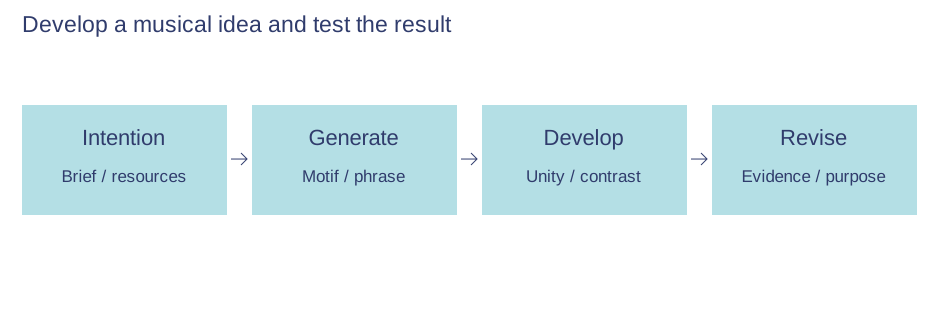
Listen, read notation and make music. Quick checks support concepts; demonstrate broader listening and practical skills through your PLC tasks.
Revise the key ideas
Brief, resources and ownership
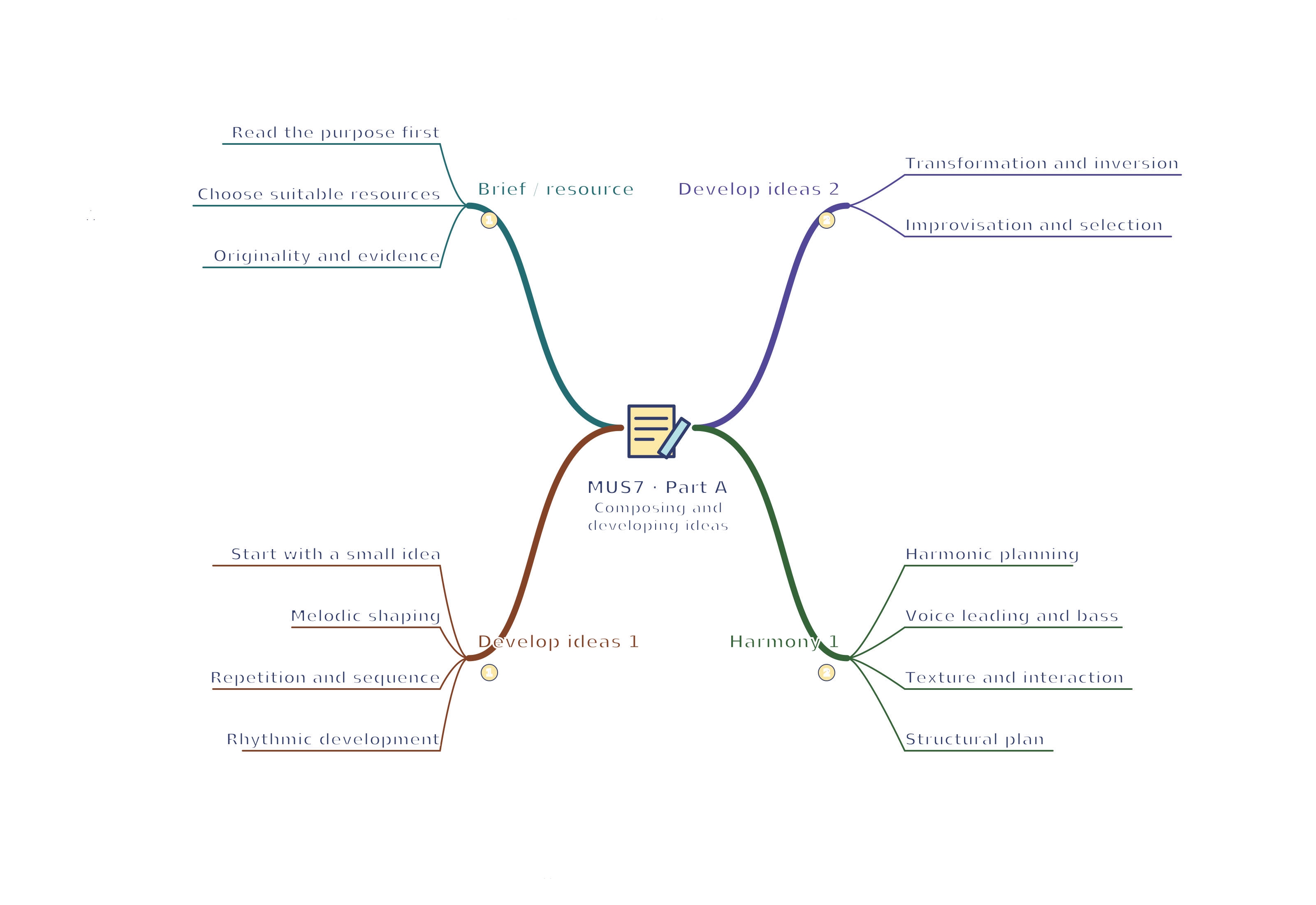
Read the purpose first — For a learner-set composition define your own purpose and resources; for the OCR-set task use the live brief provided by your teacher. Identify its area of study, stimulus and requirements before writing. A successful response makes musical decisions that address the purpose. This site's fictional exercises do not stand in for a live assessment brief.
Choose suitable resources — Test ranges, breath/bow lengths, keyboard reach, drum techniques or technology limits. A part can be within range but awkward at its tempo. Consider balance between resources and available performers. Sequenced sounds can be edited, but the resulting piece still needs musical coherence and a suitable presentation of intentions.
Originality and evidence — Develop original material and keep drafts so the teacher can authenticate the process. Distinguish inspiration from copying melody, recordings or lyrics. Discuss any permitted samples, loops or other source material and how it must be declared. Assessed work is completed under current centre/OCR conditions; teachers guide eligibility and authentication.
Generating and developing ideas
Start with a small idea — Try a short rhythm, contour, chord progression or sound gesture, then perform it. Choose material suited to the intended style and resource. An effective starting idea is not necessarily long or complicated. Record what makes it recognisable so development preserves a relationship rather than replacing it with unrelated phrases.
Melodic shaping — Balance stepwise motion and leaps, choose a range and connect significant notes to harmony. Passing notes connect more stable notes; approach and resolve them intentionally in a tonal context. A question phrase can lead towards an answering phrase with a stronger cadence. Listen to the line rather than selecting pitches mechanically from a scale.
Repetition and sequence — Repeat a motif to establish it, then sequence it at another pitch or change its ending. Check that harmonic support still fits. Too much exact repetition can stall the piece, while constant unrelated change can obscure unity. Explain the reason for the chosen repetition, such as a dance groove or a recurring character idea.
Rhythmic development — Augmentation lengthens durations and diminution shortens them proportionally. Displacement can move an idea to a different beat; syncopation changes emphasis. Check bar totals and ensemble coordination. A faster recorded tempo is not necessarily rhythmic diminution: the written values and proportions determine the device.
Transformation and inversion — Inversion reverses interval directions; transposition moves a pattern while retaining its interval relationships; fragmentation develops a smaller portion. Change mode, register or timbre to test contrasting character. Keep enough identity for the listener to hear the connection. Not every rearrangement of notes is an inversion.
Improvisation and selection — Improvise over a drone, groove or progression and record several attempts. Select a promising passage, refine it and test its connection to other material. Improvisation can remain part of the final intention where permitted, but a coherent plan is needed. Keeping everything from an improvisation does not necessarily produce a convincing structure.
Harmony, texture and form
Harmonic planning — In a tonal piece establish tonic, choose appropriate chord movements and locate cadences. Primary triads can provide a clear foundation before more complex harmony. Try a change of harmonic rhythm under a repeated melody. A chord symbol alone does not specify rhythm, register or texture; realise it musically.
Voice leading and bass — Retain common notes or use smooth movement where appropriate; contrast this with deliberate leaps or a prominent bass line. Check clashes between melody and accompaniment against the intended style. A bass can outline roots, walk or sustain a pedal. Avoid making every part compete in the same register without a musical reason.
Texture and interaction — Choose melody/accompaniment, block chords, drone or contrapuntal interaction according to purpose. Add an answering line, delayed imitation or countermelody with attention to balance. Evaluate whether parts are independent or merely double the same tune. More layers are useful only if they serve the musical design.
Structural plan — Plan sections and returns, for example binary, ternary, rondo, variation or verse/chorus. Decide what stays consistent and what contrasts in each section. A transition should connect tonal, rhythmic or textural changes. Do not label arbitrary blocks ABA unless the returning material is musically recognisable.Original teaching diagram. Apply it with the full explanation.
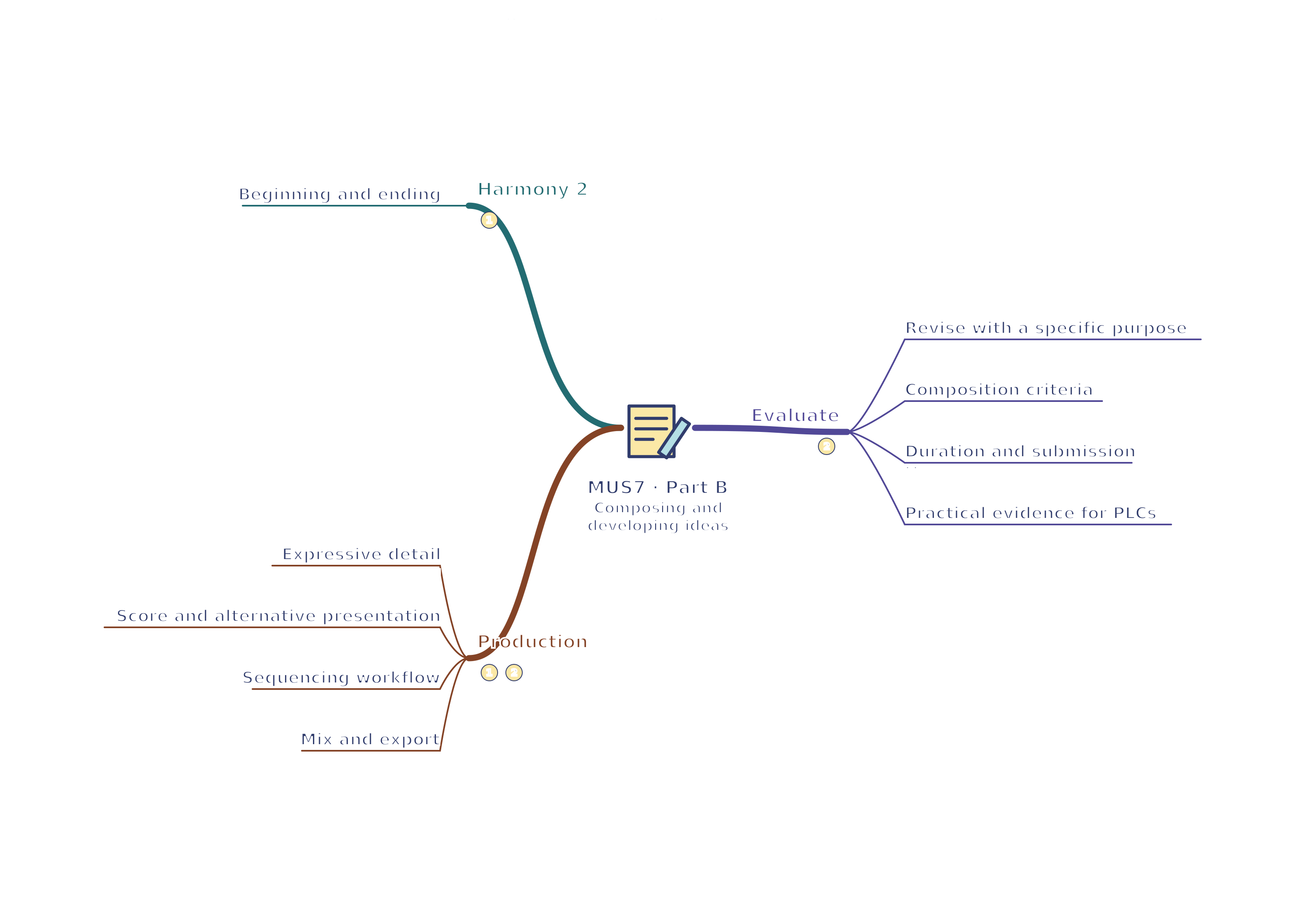
Beginning and ending — An introduction can set pulse, key or sonority before the main idea. A coda can resolve or transform earlier material. In a tonal design use a suitable cadence; in a game loop test a seamless return instead. A sudden file cutoff is not a convincing ending unless deliberately intended and communicated.
Practical production and presentation
Expressive detail — Mark phrasing, dynamics and articulation in a score or realise them in a sequenced performance. Test whether performers can execute the directions and whether the recording conveys them. A crescendo needs a clear starting and ending level. Adding many directions without hearing their effect does not demonstrate control.
Score and alternative presentation — Use readable notation, chord symbols, lead sheets or permitted alternative evidence appropriate to the work. Staff notation should have clefs, metre, key signature, bar lines and sensible grouping; parts must align. Confirm required submission formats with the teacher. A recording and clear intentions should agree rather than describe different versions.
Sequencing workflow — Set tempo/metre, choose sounds, organise tracks and label sections. Edit note starts, lengths and velocities for the style; use quantising selectively. Add effects only when they improve the intended result. MIDI data is not a finished sound recording: audition and export the actual audio, then listen to the saved file.
Mix and export — Balance lead and supporting layers, avoid clipping and test on more than one listening setup where possible. Reverb or delay should not obscure important rhythmic detail. Confirm the intended start, ending and duration after exporting. A project that plays correctly inside software may still have an incorrect exported file.
Evaluation and assessment
Revise with a specific purpose — Locate a weak transition, unclear melody, unsuitable range or repetitive passage. Try one justified change and compare recordings before/after. Explain its effect on coherence, style or expressive character. Evaluation should report what happened, not invent a story of improvement without evidence.
Composition criteria — Current OCR criteria assess how musical ideas are created/developed, how resources are used and how structure is controlled, with suitability to the brief where relevant. Sequenced work also needs appropriate realisation. Complexity alone does not guarantee quality. A short quiz can check concepts but teacher judgement of the actual composition is essential.
Duration and submission — Across both composition components the total minimum duration is three minutes. Work must meet the current supervised/authenticated award-year requirements. Do not pad a weak piece with empty repeats only to reach a minimum; develop material appropriately. Check live deadlines, permitted assistance and evidence with your teacher rather than assuming an old brief remains current.
Practical evidence for PLCs — For a composition goal, provide an original score, recording, rehearsal or sequenced example with an explanation of the decisions. Linked questions test selected concepts and cannot certify authorship, expressive control or a complete response to a brief. Use the task and teacher feedback alongside the confidence checklist.
Test yourself
30 questions · Random sets of 10. These quick checks support revision; practise longer explanations and justified judgements too.
Mind map
Use the branches to recall the ideas and explain their connections. Check the revision notes for the full detail.
View MUS7 · Brief / resource / Develop ideas 1 / Develop ideas 2 / Harmony 1 mind mapOpen the full-size map to zoom. Download the PDF to print on A4 or enlarge to A3.
 Mr Kidman's Classroom