Read the notes, recall their sources and practise explaining contrasting views. The 30 quick questions support revision; also practise extended explanations and justified evaluations.
Revise the key ideas
Design and causation
Theism is belief in God; atheism rejects or lacks belief in gods, while agnosticism holds that God's existence is unknown or unknowable. Humanism grounds ethical living in human reason, wellbeing and responsibility without requiring the supernatural. Buddhism commonly does not posit a creator God, though many traditions include celestial Buddhas or other beings. Distinguish these positions rather than assume every non-theist shares an identical worldview.
Theism affirms belief in God, atheism denies or lacks that belief, and agnosticism concerns uncertainty or the limits of knowledge. Humanism can ground ethics in human reason and welfare without divine authority.
Buddhism generally does not centre on a creator God, but this does not mean every Buddhist denies all spiritual beings or experiences. In this theme, the specified contrasts on miracles, visions and nature include Christianity and non-religious views.
The Design argument infers an intelligent designer from order, complexity or apparent purpose in the universe. Paley's watch analogy compares organised natural structures with an object whose parts serve a purpose. A believer may interpret this as evidence for God. The inference is not a direct observation of a designer; the quality of the analogy and alternative explanations need evaluation.
The Design argument moves from apparent order, purpose or suitability for life towards an intelligent cause. Paley's watch analogy compares organised parts with an artefact whose function suggests a maker.
Its strength is a positive explanation of observed order; the conclusion needs more argument to establish that the cause is the Christian God. Distinguish an inference from a logical certainty.
Supporters argue that the universe's regularities and conditions for life are striking and that design explains them. Critics note that an imperfect world could imply an imperfect designer; the analogy may not justify one omnipotent, loving God. A complex natural system is not exactly like a human artefact. An argument can offer reasons for belief without conclusively proving every Christian attribute.
An analogy is stronger when the compared cases are relevantly similar. Critics argue that a universe is not a manufactured object whose making we have observed.
Disease and destructive natural events challenge the claim of perfect design. A defender may reply that a wider purpose exists, but that reply needs explanation rather than ignoring the evidence.
Evolution by natural selection offers an explanation of biological adaptation without assuming a separate design intervention for every feature. Scientific accounts of cosmic development also explain processes through natural laws. A believer may ask why those laws exist or hold that God works through them. Science can challenge particular religious claims without logically settling every question of ultimate existence or purpose.
Natural selection can explain apparent biological purpose through adaptation. This challenges an inference that each useful structure requires a separate act of divine design.
A believer may locate God in the existence of natural laws or their ultimate purpose. A critic may argue that natural explanations are sufficient; neither position should misdescribe scientific investigation as simply a matter of faith.
The First Cause argument reasons that things in the universe depend on causes and that an explanation ultimately requires an uncaused cause, identified by believers as God. Some versions concern an initial event, others continuing dependence. God is proposed as not needing the same type of cause as dependent things. Explain this proposal before criticising it.
One First Cause version argues that a series of dependent causes requires an ultimate explanation. Another focuses on a universe with a beginning; they do not make exactly the same assumptions.
A strength is that it asks why there is an existing universe at all rather than only describing an event within it. The proposal of God as necessary rather than dependent is part of the argument.
Critics ask why God is exempt from needing a cause, whether the universe could be a brute fact, and whether causal rules apply beyond space and time. Even if a first cause exists, more reasoning is needed to identify it with a particular religion's God. Supporters reply that necessary being differs from dependent things. Weigh the assumptions rather than simply repeat 'who made God?' without explanation.
Critics question whether a causal principle established within the universe can be applied to the universe as a whole. They may also ask why the ultimate explanation could not be impersonal.
Even if an ultimate cause is accepted, it does not by itself establish incarnation, love or the Trinity. A believer requires further reasons for those particular claims.
Miracles and suffering
A miracle is an event interpreted as divine action, often apparently beyond normal natural explanation. John 2:1–11 describes Jesus turning water into wine at Cana, which Christians may understand as a sign of his authority. The argument from miracles reasons from such events to God's existence. Interpreting an event as miraculous is different from merely admitting its cause is currently unknown.
At Cana in John 2:1–11, water becoming wine is presented as a sign revealing Jesus' glory and inspiring belief. This connects the event with a religious interpretation rather than simply unusual chemistry.
The miracle argument infers divine agency from an event believed to exceed normal explanation. Its force depends on the evidence for the event and on excluding reasonable alternatives.
Supporters appeal to testimony, religious context and transformative effects. Critics propose mistaken diagnosis, coincidence, exaggeration or natural causes not yet understood; reports from different religions also complicate identification of one God. An extraordinary claim requires careful evidence. Transformation may demonstrate the experience's importance for someone without establishing a supernatural cause for every observer.
Eyewitness sincerity is different from accuracy: a person may honestly misremember or misunderstand. Corroboration, reliable records and attention to alternatives strengthen assessment.
An atheist may accept a recovery while rejecting the claim that it proves God's intervention. A Christian may interpret timing, prayer and religious context as supporting that interpretation.
Moral evil results from human actions such as cruelty; natural evil refers to suffering from events such as earthquakes or disease. The problem of evil asks how these fit an omnipotent, loving God. An earthquake's effects can include human contributions such as unsafe buildings, so categories can overlap in a real case. Do not assume victims deserve suffering.
Moral evil includes deliberate cruelty; natural evil includes suffering from disease or geological events. Human decisions can worsen a natural event, so one case can involve both.
The argument asks whether suffering is compatible with a God who is both willing and able to prevent it. It can challenge belief without implying that every sufferer loses faith.
The free-will defence argues that meaningful choice permits the possibility of wrongdoing; removing every harmful choice might remove freedom. It addresses moral evil more directly than natural suffering. Soul-making responses suggest challenges can develop virtues, but critics ask about extreme suffering and victims who gain no apparent benefit. Some believers emphasise mystery and God's presence with sufferers rather than a complete explanation.
Free will provides a possible explanation for human wrongdoing, but does not directly explain why infants suffer from disease. A response should recognise that limit.
Soul-making appeals to virtues such as courage and compassion developed through difficulty. A criticism is that some suffering destroys opportunities for growth rather than creating them.
Belief in Christ sharing suffering can support trust and practical compassion. This addresses God's relationship with sufferers even where it is not offered as a full logical solution to evil.
Revelation and experience
General revelation is knowledge of the divine through sources available widely, such as nature and scripture. A Christian may regard creation as revealing God's power or the Bible as revealing character and purposes. A humanist can appreciate nature and study scripture without accepting divine authorship. Different interpretations mean availability does not guarantee identical conclusions.
General revelation through nature is potentially available widely: order or beauty may lead someone towards belief. A non-religious observer can attribute the experience to perception and natural processes.
Scripture can be treated as general revelation because it communicates teachings beyond one person's private experience. Disagreements over authorship and interpretation affect what knowledge it is thought to provide.
Special revelation is a particular experience understood as disclosure of the divine, such as a vision. Acts 9 describes Saul encountering the risen Jesus on the road to Damascus, leading to conversion and mission as Paul. A vision can involve an appearance or perception with religious significance; it need not be public. Its effects can be significant while its interpretation remains disputed.
In Acts 9:1–19, Saul's encounter on the road to Damascus changes his direction from persecuting Christians to becoming a follower of Christ. Christians may understand the vision as a disclosure of Jesus' authority.
A vision is special revelation because it is a particular experience rather than evidence equally available to all. A critic can ask whether it arose from psychological or natural causes.
Lasting transformation can support the claim that an experience mattered. It is not alone a proof that its cause was divine.
Enlightenment in Buddhism is profound awakening to reality and release from ignorance, linked with the Buddha's experience under the Bodhi tree. It need not reveal a personal creator God. It can be a source of knowledge about ultimate reality and change how someone lives. Compare it with revelation by examining what is understood, how knowledge is gained and the effect on conduct.
Enlightenment can be understood as insight into ultimate reality, such as the Buddha's awakening to suffering and liberation. It should not automatically be described as a creator speaking to someone.
Its value can be judged by coherence, practice and changes in conduct; critics may question how a private insight can be verified by others or reconciled with conflicting claims.
Accounts of the divine may describe a personal God who relates to people or an impersonal ultimate reality. Immanent means present within creation; transcendent means beyond it, and Christians can affirm both. Omnipotence is unlimited power and omniscience complete knowledge. Experiences and scriptures can lead to different descriptions; these terms should be defined before weighing apparent conflicts.
Omnipotent means all-powerful and omniscient means all-knowing. Personal describes a divine reality with which one can relate, while impersonal describes ultimate reality without human-like personality.
Immanent means present or active within the world; transcendent means beyond it. Christians can affirm both, so the terms are not necessarily competing alternatives.
A source may support one attribute without establishing every other attribute. For example, perceived order in nature does not alone demonstrate forgiveness or detailed knowledge of individuals.
Religious experiences may give the experiencer strong conviction, moral change and belonging. Critics point to psychological states, illness, cultural expectations, deception or mistaken memory. Conflicting reports raise questions about reliability, while believers may reply that human interpretations differ. Evaluate evidence, coherence and effects; neither sincerity nor disagreement alone settles whether the experience had a divine cause.
Competing religious experiences may lead to incompatible descriptions of ultimate reality. Supporters can interpret them as different insights, while critics ask how to distinguish truth from projection.
Possible explanations include a genuine disclosure, deception, sincere mistake or altered mental state. Evaluate the particular evidence without assuming that every believer lies or that every moving account is reliable.
Test yourself
30 questions · Random sets of 10. These quick checks support revision; practise longer explanations and justified judgements too.
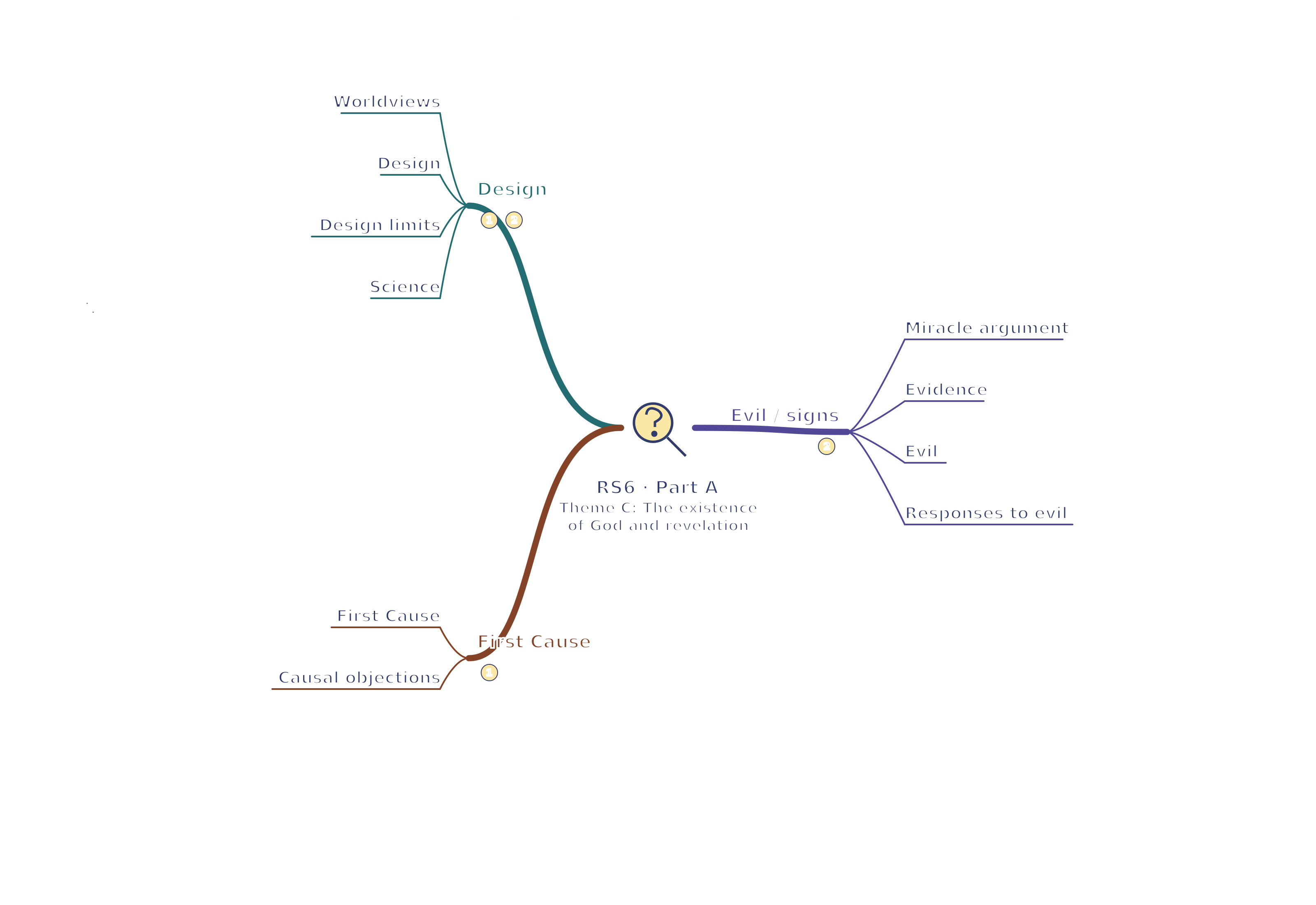
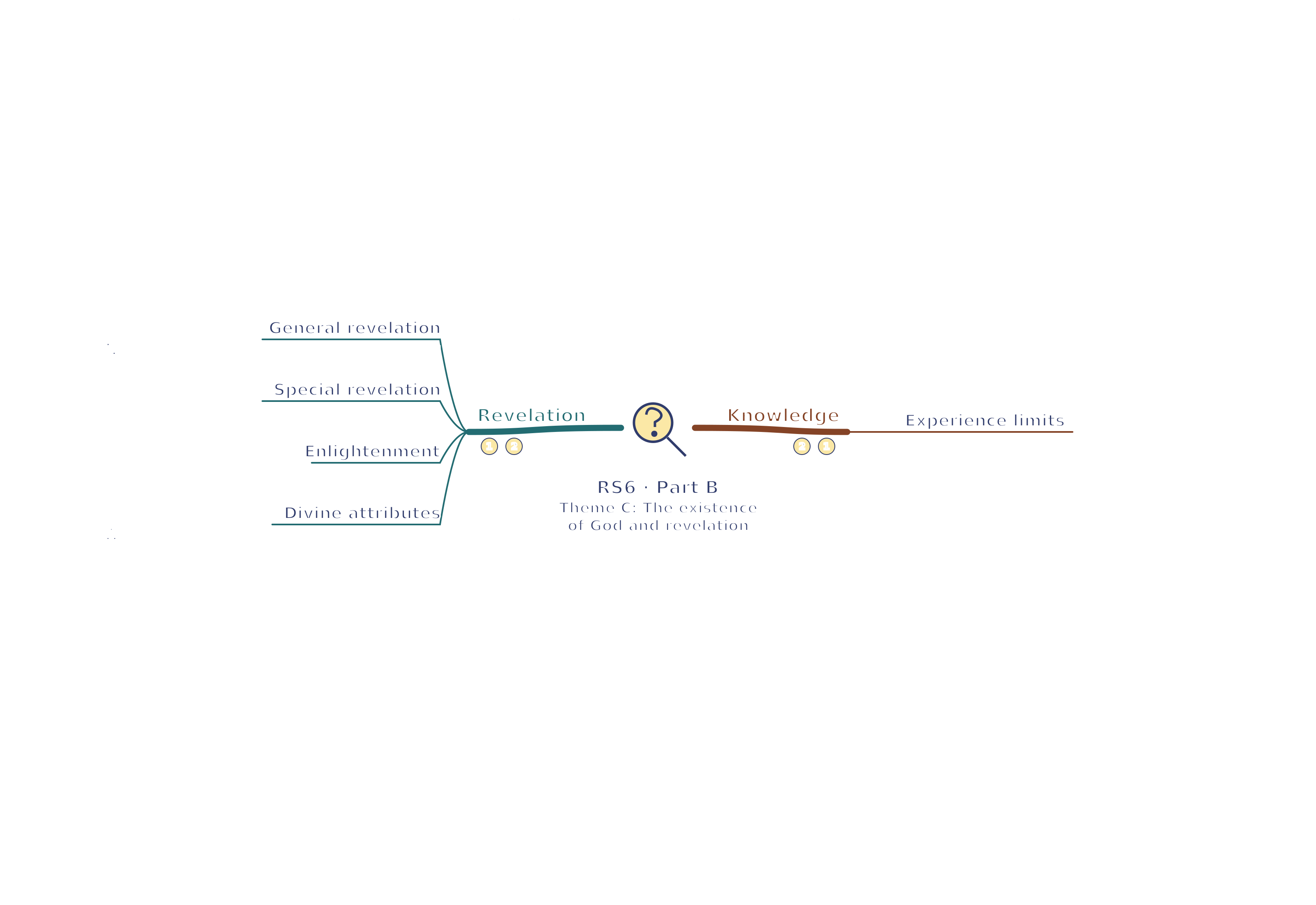
Mind map
Use the branches to recall the ideas and explain their connections. Check the revision notes for the full detail.
RS6 · Part A
View RS6 · Part A mind mapOpen the full-size map to zoom. Download the PDF to print on A4 or enlarge to A3.
 Mr Kidman's Classroom