Read the notes, recall their sources and practise explaining contrasting views. The 30 quick questions support revision; also practise extended explanations and justified evaluations.
Revise the key ideas
Origins and value
The Big Bang describes the universe expanding from an early hot, dense state; it does not by itself answer every question about ultimate purpose. Some Christians take Genesis literally; others believe God works through natural processes and read it as teaching that creation depends on God. Buddhism generally does not require a creator, focusing on conditioned existence. Scientific and religious claims can conflict or address different questions.
The Big Bang describes the development of the universe from an early hot, dense state. It is a scientific account of physical development, not by itself an answer to whether existence has a divine purpose.
Some Christians reject a literal conflict by understanding Genesis as theological teaching. Buddhists generally do not require a creator explanation and may focus on dependent conditions rather than a first divine maker.
Evolution describes changes in inherited characteristics across generations and common ancestry through processes including natural selection. Literal creationists may reject aspects that conflict with their reading of Genesis. Many Christians accept evolution while seeing human dignity as grounded in God. Buddhist impermanence is compatible with change, but scientific evolution is not identical to the spiritual teaching of rebirth.
Evolution explains changes in living populations through inherited variation and processes including natural selection. It should not be described as an individual deciding to evolve during its lifetime.
A literal reading of human creation and acceptance of common ancestry can conflict; a non-literal Christian may see evolutionary processes as compatible with God's purpose. Buddhist accounts emphasise conditioned existence rather than humans created in God's image.
Awe and wonder are responses to the world's beauty, scale or complexity. A Christian may interpret these as appreciation of God's creation; a Buddhist may reflect on interdependence; a humanist may value nature without a supernatural explanation. The same experience does not force one conclusion. These responses can inspire curiosity, gratitude and protection of the environment.
Awe and wonder can arise when people encounter the scale or beauty of nature. A Christian may interpret this as pointing to a creator, while a non-religious person can appreciate the same experience without a divine explanation.
Environment and animals
Stewardship is responsible care for the world, understood by many Christians as a duty entrusted by God. Dominion in Genesis 1 can mean human authority, but it need not justify abuse; Genesis 2:15 links humanity with tending the garden. Buddhist interdependence and compassion support reducing harm. Pollution and waste affect other people and future generations, so environmental responsibility can be both religious and secular.
Genesis 1:26–28 associates humans with a distinctive role and dominion. Some understand authority as responsibility, while exploitative readings are criticised for ignoring care for creation.
Genesis 2:15 portrays humans tending and keeping the garden. This supports stewardship: using resources responsibly as a trust rather than assuming ownership permits destruction.
Buddhist non-harming and interdependence can support environmental care because damage to habitats affects living beings. The justification differs from responsibility to a creator but can motivate similar action.
Natural resources include fuels, forests, water and minerals. Overconsumption can deplete resources; pollution can damage health and ecosystems. Actions include conserving energy, reusing materials, protecting habitats and supporting policies that reduce harm. Choices may involve trade-offs, such as livelihoods versus conservation. Ethical evaluation considers long-term consequences and fair distribution rather than assuming every solution has no costs.
Pollution can damage air, water, soil and health; overuse of finite resources can deprive future generations. Conservation, reuse and lower waste are examples of practical responses.
An evaluation should consider competing needs: energy and employment may benefit people while extraction damages ecosystems. Stewardship and compassion supply reasons to reduce harm rather than pretend no trade-off exists.
Animal experimentation may aim to test treatments or gain scientific understanding. Supporters stress potential benefit and the duty to reduce suffering; opponents question causing harm to animals for human gain. Some Christians permit carefully justified use under responsible dominion, while others stress stewardship. Buddhists often object through the first precept and compassion, though responses vary. Consider alternatives, necessity and minimising harm.
An argument supporting animal experiments appeals to medical benefit when alternatives are unavailable and suffering is minimised. An objection appeals to sentience and the wrongness of using vulnerable beings merely as tools.
Christian views may balance dominion with responsible care; Buddhist objections can draw on the first precept and compassion. Intention to help humans does not make animal suffering irrelevant.
Distinguish medical testing from experiments for convenience or luxury products. The purpose, alternatives and extent of harm can affect an ethical judgement.
Some Christians eat meat, referring to the permission associated with Genesis 9, while others choose vegetarianism from care for creation. Many Buddhists avoid meat to reduce killing; some Theravada monastics accept offered meat under traditional conditions rather than demand a special diet. Dhammapada 129–130 connects awareness of others' fear of death with restraint. Avoid claiming every Buddhist is vegetarian.
Arguments for eating meat may refer to permission in Genesis 9; arguments for vegetarianism may emphasise stewardship and limiting suffering. Christians are not united around one diet.
Dhammapada 129–130 connects beings' fear of violence and death with restraint. A Buddhist can apply this to diet, though monastic rules and lay customs differ.
Value of human life
Sanctity of life is the belief that life has a special or sacred value; Christians often ground it in humans being made in God's image (Genesis 1:27). Buddhist respect for sentient life relates to compassion and avoiding killing without requiring a creator. Humanists may ground dignity in shared humanity. Special value does not settle every difficult case without further reasoning.
Sanctity of life concerns inherent value rather than usefulness, wealth or ability. Genesis 1:27 can support Christian belief that human dignity derives from creation in God's image.
Buddhist respect for life can be based on the first precept and compassion rather than a creator's ownership. The grounds differ even where both traditions oppose taking life.
Quality of life concerns wellbeing, suffering, relationships and the ability to experience a worthwhile life. It is distinct from sanctity, which emphasises life's inherent value. Both can matter in ethical decisions; poor health does not remove dignity. Assessments of another person's quality of life must avoid assuming disability means an unhappy or worthless existence.
Quality of life considers experiences such as pain, relationships, autonomy and opportunities. A person may value support that improves these without judging lives with disability intrinsically less worthy.
Sanctity and quality arguments can overlap: someone who opposes killing can still regard pain relief and good care as moral necessities.
Abortion
Abortion deliberately ends a pregnancy. The debate includes the moral status of the unborn, bodily autonomy, the pregnant person's circumstances and risks to life. Catholic teaching generally opposes direct abortion, stressing protection from conception. Some other Christians permit it in limited difficult circumstances. Explain the reasoning rather than assume Christianity has one unanimous response.
Catholic objections to direct abortion emphasise protection of unborn life and the prohibition on deliberately killing the innocent. Other Christians may allow abortion in grave circumstances, appealing to compassion and the mother's welfare.
When the mother's life is at risk, distinguish an action intended to end a pregnancy from treatment intended to address a serious medical condition with an unintended fetal death. Ethical accounts of intention differ; do not claim all Christians give the same answer.
Buddhist opposition to abortion can rest on the first precept and the belief that ending developing life has karmic consequences. Some Buddhists consider compassion, intention and circumstances, including serious risk to the mother's life; this does not erase the moral difficulty. Non-religious arguments may stress autonomy and wellbeing, but non-religious people also disagree. Caring support matters whichever position someone holds.
The first precept can provide a Buddhist reason to oppose abortion as taking life. Compassion also requires attention to the pregnant person's suffering, intention and circumstances.
A careful comparison identifies a shared concern for life and possible differences in authority or reasoning. Neither 'all Buddhists permit it' nor 'no Buddhist considers circumstances' is adequate.
End of life
Euthanasia is deliberately ending a person's life to relieve suffering; voluntary euthanasia follows the competent person's request. Assisted suicide involves helping the person take their own life. These are not identical to palliative care aimed at comfort or refusing burdensome treatment. Intention, consent, safeguards and the distinction between causing death and accepting a natural dying process are central to the debate.
Voluntary euthanasia involves a request by the person; non-voluntary euthanasia involves someone unable to give consent. Assisted suicide is distinct because the person performs the final act themselves.
Withdrawing disproportionate treatment or providing appropriate pain relief is not automatically an intention to kill. Ethical arguments depend on consent, intention, likely consequences and the care available.
Many Christians oppose euthanasia through sanctity of life and God's authority over life; hospices express compassion without intentionally killing. Some Christians support voluntary euthanasia in exceptional circumstances because relieving extreme suffering can be loving. Buddhism raises concerns about killing, intention and karma while valuing compassion. A Buddhist or Christian concern for suffering does not automatically dictate one solution.
Christians opposing euthanasia may argue that life belongs to God and vulnerable people need protection. Some Christians supporting a request may emphasise compassion and autonomy, but this is not a shared position across churches.
Buddhist objections can appeal to the first precept, while discussion of compassion examines motives and the patient's distress. Palliative care can express compassion without deliberately ending life.
Supporters of voluntary euthanasia may emphasise autonomy, dignity and relief of unbearable suffering. Opponents raise risks of pressure, mistakes, unequal care and weakening protection for vulnerable people. The principle of utility assesses consequences; a rights-based view may emphasise both choice and protection. Evaluation should weigh the best arguments rather than assume either side wants people to suffer.
An autonomy argument says competent people should have a voice over their own treatment and suffering. A protection argument asks whether pressure, fear of being a burden or inadequate care can undermine a free choice.
Evaluation should weigh relief of suffering against the possibility of coercion or mistakes. A justified conclusion must address the strongest objection, not simply list advantages.
Christian resurrection and judgement can support hope beyond death and responsibility for earthly conduct. Buddhist rebirth, kamma and nibbana encourage intentional ethical action and awareness of impermanence. Humanists generally focus on this life and the legacy of actions rather than an afterlife. None of these views means bereaved people cannot grieve or that followers must disregard present suffering.
Christian hope of resurrection can support the continuing value of a person approaching death and care for the bereaved. It does not imply that death should be deliberately hastened.
Buddhist belief in rebirth can make intention at death important and encourage compassionate support. Non-religious people can value a finite life and dignified care without believing in an afterlife.
Test yourself
30 questions · Random sets of 10. These quick checks support revision; practise longer explanations and justified judgements too.
Mind map
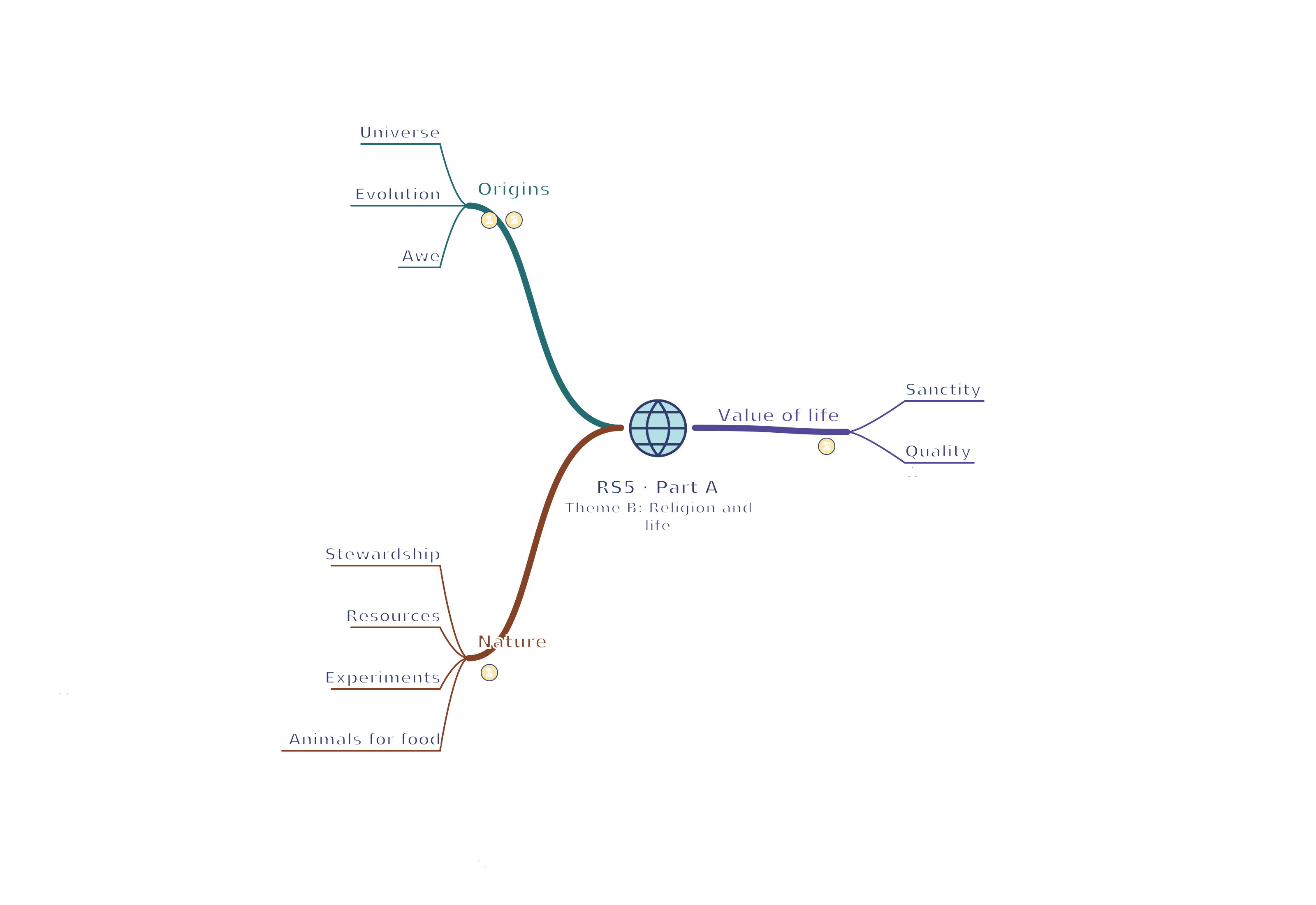
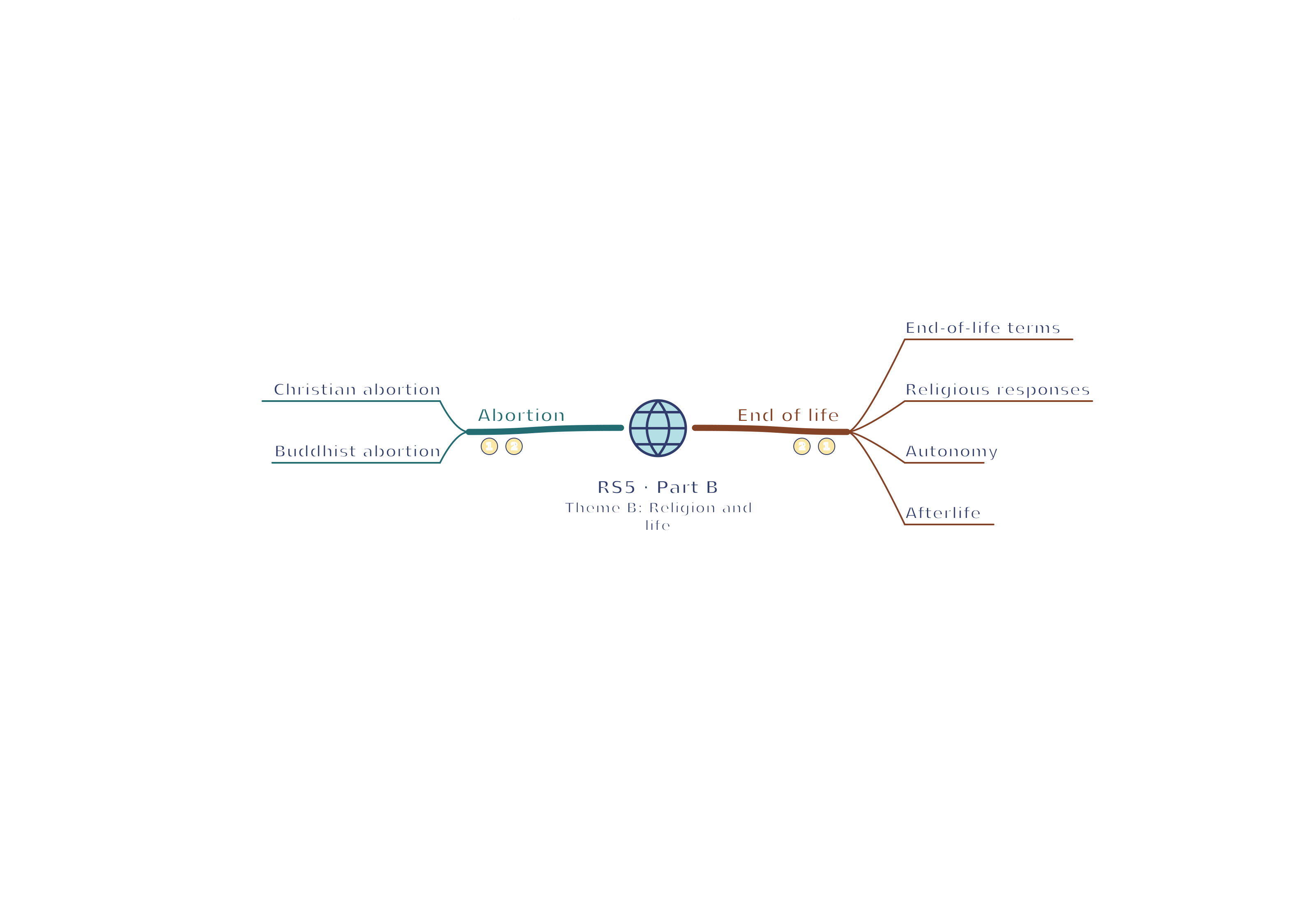
Use the branches to recall the ideas and explain their connections. Check the revision notes for the full detail.
RS5 · Part A
View RS5 · Part A mind mapOpen the full-size map to zoom. Download the PDF to print on A4 or enlarge to A3.
 Mr Kidman's Classroom