Use concepts, evidence and competing explanations to investigate society. The 30 quick questions support recall and application; practise the broader written tasks in your PLC too.
Revise the key ideas
Studying society
Sociological imagination — Sociology investigates social relationships, institutions and patterns using evidence. A student's educational experience can reflect family resources, school organisation and policies as well as personal choices. A sociological explanation asks how these levels connect rather than treating one person's story as proof of a general pattern.
Society and institutions — A society contains interacting groups, shared arrangements and institutions such as families, education, the economy and government. Institutions organise important activities through roles and rules. They can provide support while distributing resources unequally; their effects need investigation rather than assuming they benefit everyone equally.
Structure and agency — Social structure refers to relatively enduring patterns such as class divisions and institutional rules. Agency is people's capacity to act and make choices. Expensive transport may constrain school choice without determining every family's decision. Explain constraints and responses together; neither unlimited freedom nor total social determination is a sufficient account.
Culture and subculture — Culture includes learned values, norms, symbols and ways of life. A subculture has distinctive meanings within a wider society, such as a youth group's style. Cultural diversity does not mean everyone in a category behaves identically. Sociologists investigate differences, similarities and changes rather than ranking cultures as naturally superior.
Norms and values — Values are beliefs about what matters, such as fairness. Norms are expectations about conduct, such as taking turns. The same value can support disputed norms: people may disagree about which school policy is fair. Norms can be written or unwritten, and both can change with historical context.
Roles and status — A role is expected behaviour associated with a position, such as teacher. Status refers to a social position or its prestige. Ascribed status is allocated without personal achievement, while achieved status is gained through action or performance. Role conflict occurs when expectations clash, for example paid work and caring responsibilities competing for time.
Socialisation and control
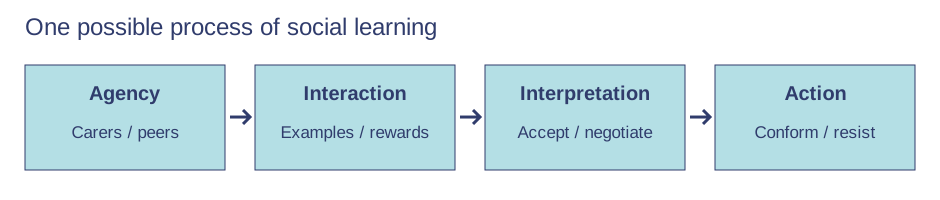
Primary socialisation — Primary socialisation usually occurs through early family or caring relationships. Children learn language, habits and meanings through interaction, imitation and rewards. This is a social process, not evidence that one family form is uniquely capable of raising children; experiences differ within every form.Selected overview. Explain the qualifications using the notes.
Secondary socialisation — Secondary socialisation develops beyond early carers through education, peer groups, media, religion and workplaces. An agency of socialisation is a group or institution involved in this learning. Agencies may reinforce or contradict one another, such as peer approval challenging a school's rules.
Gender socialisation — Canalisation channels children towards particular activities; manipulation encourages conduct thought suitable for a gender. Toys, praise, media images and adult examples can communicate gender roles. These mechanisms are explanations of how expectations may be learned, not proof that all children conform or that abilities are biologically fixed by stereotypes.
Social control — Social control concerns ways of encouraging compliance with norms. Formal control uses authorised rules and institutions, such as courts. Informal control uses everyday responses, such as approval or ridicule. Positive sanctions reward conduct and negative sanctions discourage it; informal sanctions can be powerful without being written law.
Power and authority — Power is the capacity to influence conduct or outcomes, including despite resistance. Authority is power regarded as legitimate by those subject to it. A person can obey through fear without accepting legitimacy. Analyse who makes decisions, controls resources and shapes agendas as well as visible commands.
Labelling and discrimination — Labelling attaches a social definition to a person or action. A stereotype treats a group as if all members share a trait. Prejudice is a preconceived judgement; discrimination is unequal treatment. Racism and sexism can operate through institutions as well as individuals. A label does not inevitably become a person's identity, but it can change the opportunities offered.
Classical sociology in context
Durkheim's context — Émile Durkheim worked in late nineteenth- and early twentieth-century France during industrial and political change. He examined how social bonds and shared rules make collective life possible. His approach helped establish sociology as a study of social patterns with causes beyond individual preference.
Durkheim's contribution — Durkheim argued that social facts, such as institutional rules, exist beyond particular individuals and exert pressures on them. Education can transmit common values and self-discipline. Functionalists use this emphasis on interdependence, but critics ask whose values dominate and whether solidarity accounts adequately for conflict and exclusion.
Marx's context — Karl Marx wrote in nineteenth-century Europe, including Britain, as industrial capitalism expanded. He examined relations between owners of productive property and workers selling labour. His argument concerned a historical economic system; it should not be simplified into a claim that every modern occupation fits only one lifestyle category.
Marx's contribution — For Marx, the bourgeoisie own the means of production and the proletariat sell labour power. Owners appropriate surplus value from workers' labour. Institutions and ideology can help reproduce this unequal relationship. Class consciousness involves recognising shared class interests; false consciousness obscures exploitation. Critics point to complex middle classes, social mobility and influences beyond ownership.
Weber's context — Max Weber worked in late nineteenth- and early twentieth-century Germany. He examined the meanings people attach to action and the development of bureaucracy and capitalism. His approach combines unequal resources with interpretation, avoiding a reduction of every social relationship to economic ownership alone.
Weber's contribution — Weber distinguished market position, social prestige and organised power. A well-qualified employee can lack ownership yet have valuable skills and strong market chances. People may organise through religion, ethnicity or political interests across classes. This complicates Marx's model; the categories can overlap rather than functioning as unrelated boxes.
Perspectives and debates
Functionalism — Functionalists ask how institutions contribute to continuity, cooperation and role allocation. Value consensus means shared basic values. Education and families can socialise new members. Critics argue that apparent agreement may conceal unequal power and that institutions can harm some groups even while stabilising society.
Marxism — Marxists examine how ownership and class power influence institutions such as schools and families. The claim that an institution reproduces capitalism needs a mechanism, such as preparing obedient workers or supporting unpaid care. Evaluate evidence and alternative interpretations; do not merely label every disadvantage Marxist.
Feminism — Feminist perspectives investigate gender inequality in households, paid work, culture and politics. Patriarchy refers to arrangements supporting male domination. Feminists differ about its sources and the best changes, and recognise that class, ethnicity and other inequalities can shape experiences. Avoid treating women or men as internally uniform groups.
Interactionism — Interactionists examine how people interpret situations, negotiate identities and respond to labels. A teacher's expectation may influence interaction and a pupil's response. Detailed small-scale research can reveal processes missed in broad statistics, but critics ask whether it sufficiently explains wider structural inequalities.
Conflict and consensus — Consensus approaches stress shared interests and integration; conflict approaches stress unequal interests and struggles over resources. Real societies can contain both cooperation and conflict. Compare how each perspective explains the same example, including what evidence could support or challenge it, rather than assuming they ask identical questions.
Changing knowledge — Classic theories were developed in particular times and places. Later work has challenged male-centred samples, assumptions about heterosexual families and claims of inevitable economic change. Sociological knowledge develops through critique and research. A study's age does not by itself prove it wrong, but transfer to a new setting needs justification.
Social issues and assessment reasoning
Linked institutions — Education influences qualifications and labour-market chances; family resources influence education; inequality can affect exposure to crime and criminal justice. Distinguish mechanisms from correlation. A pattern connecting low income and outcomes does not establish that individuals choose those outcomes or that income is the only cause.
Social problems and public debate — A social issue becomes a public problem through competing claims about harm, responsibility and solutions. Media attention can change perceptions without an equal change in incidence. Analyse which groups define an issue, whose voices are absent and what data measure, rather than taking a headline as a representative account.
Continuity and change — Explain both persistence and change in practices, institutions and attitudes. Compare the same geographical coverage, age group and definition before drawing a trend. A change in recorded categories can alter a series even when behaviour is stable. State dates and avoid assuming change proceeds uniformly across all groups.
Reading sociological texts — When given an extract, identify its actual claim and supporting reasoning. Link it to the relevant perspective and study rather than adding a memorised biography. Distinguish the author's argument from your judgement. Consider sample, setting and alternative explanations when assessing how well the evidence supports a wider claim.
Applying an item — Application requires connecting a concept to a detail in the question. If an item describes unequal school transport access, explain how resources constrain parental choice. Repeating the item or giving an unrelated definition does not establish the link. An example supports reasoning but cannot alone prove a general causal relationship.
Evaluating an argument — Develop a claim, explain its mechanism, support it with evidence and assess a specific limitation. Compare rival explanations on the same issue, then justify a conclusion. Lists of names and unsupported statements that a theory is biased do not evaluate its explanatory value.
Research in context — A survey can compare patterns, while interviews explore meanings. Research with children, prisoners or dependent family members involves particular access and power issues. Ask what a method can answer, what it misses and whether participation is safe and voluntary. SOC6 develops the design and evaluation of each method.
Alienation and belonging — Alienation concerns feeling separated from one's work, its products, other people or one's own capacities; Marx linked it to capitalist labour relations. Social cohesion concerns bonds that connect a group; community may involve shared locality, identity or relationships. Cohesion can exist with inequalities, and alienation is not simply living geographically far from others.
Worldviews and public meanings — A world view is an overall understanding of social reality; a theoretical perspective supplies concepts and explanations. A social convention is an accepted practice. Identity concerns how people understand themselves and are recognised; stigma discredits an identity and can restrict acceptance. Interpret these meanings through evidence rather than assuming a group's label reveals everyone's outlook.
Test yourself
30 questions · Random sets of 10. These quick checks support revision; practise longer explanations and justified judgements too.
Mind map
Use the branches to recall the ideas and explain their connections. Check the revision notes for the full detail.
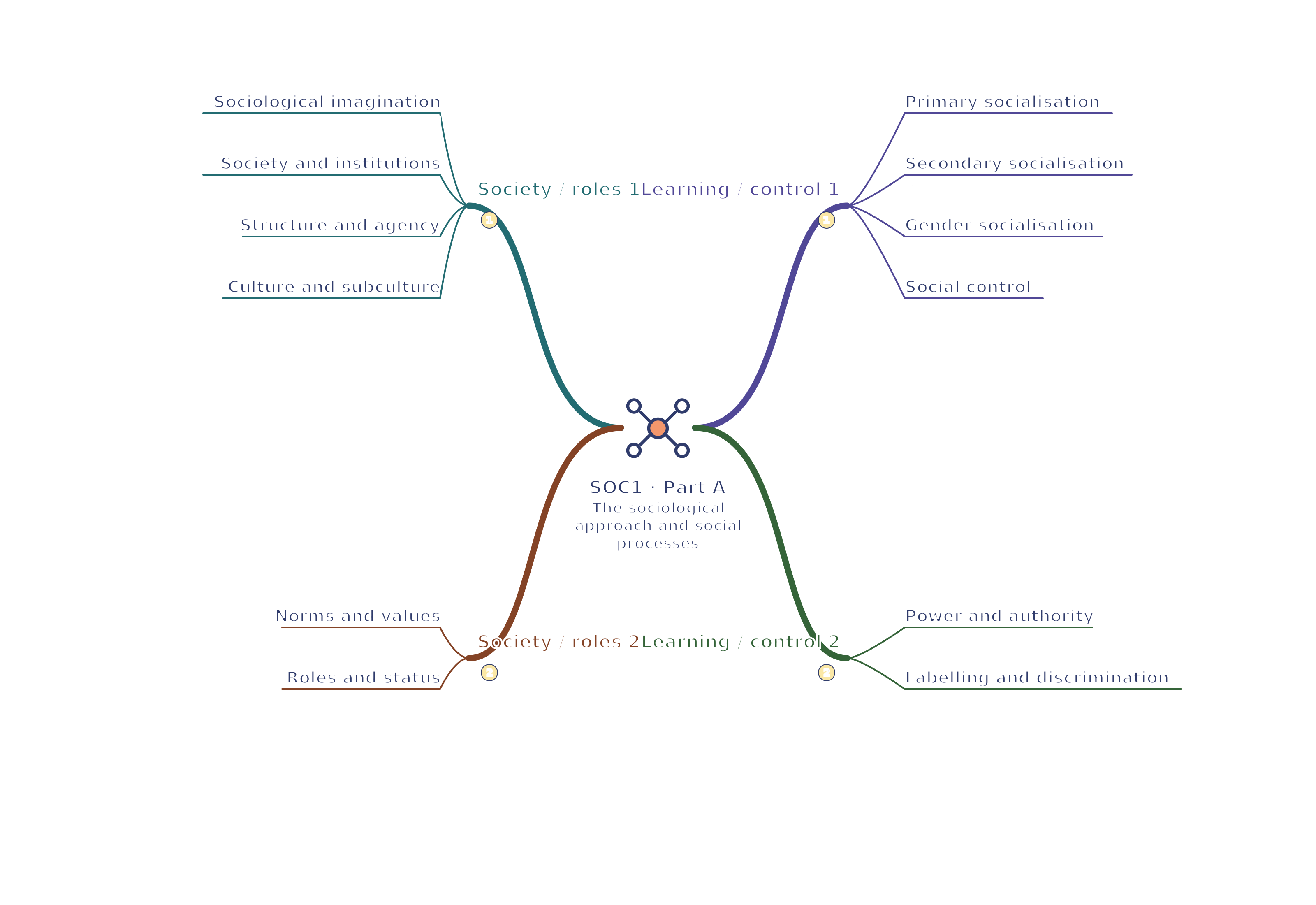
SOC1 · Society / roles 1 / Society / roles 2 / Learning / control 1 / Learning / control 2
View SOC1 · Society / roles 1 / Society / roles 2 / Learning / control 1 / Learning / control 2 mind mapOpen the full-size map to zoom. Download the PDF to print on A4 or enlarge to A3.
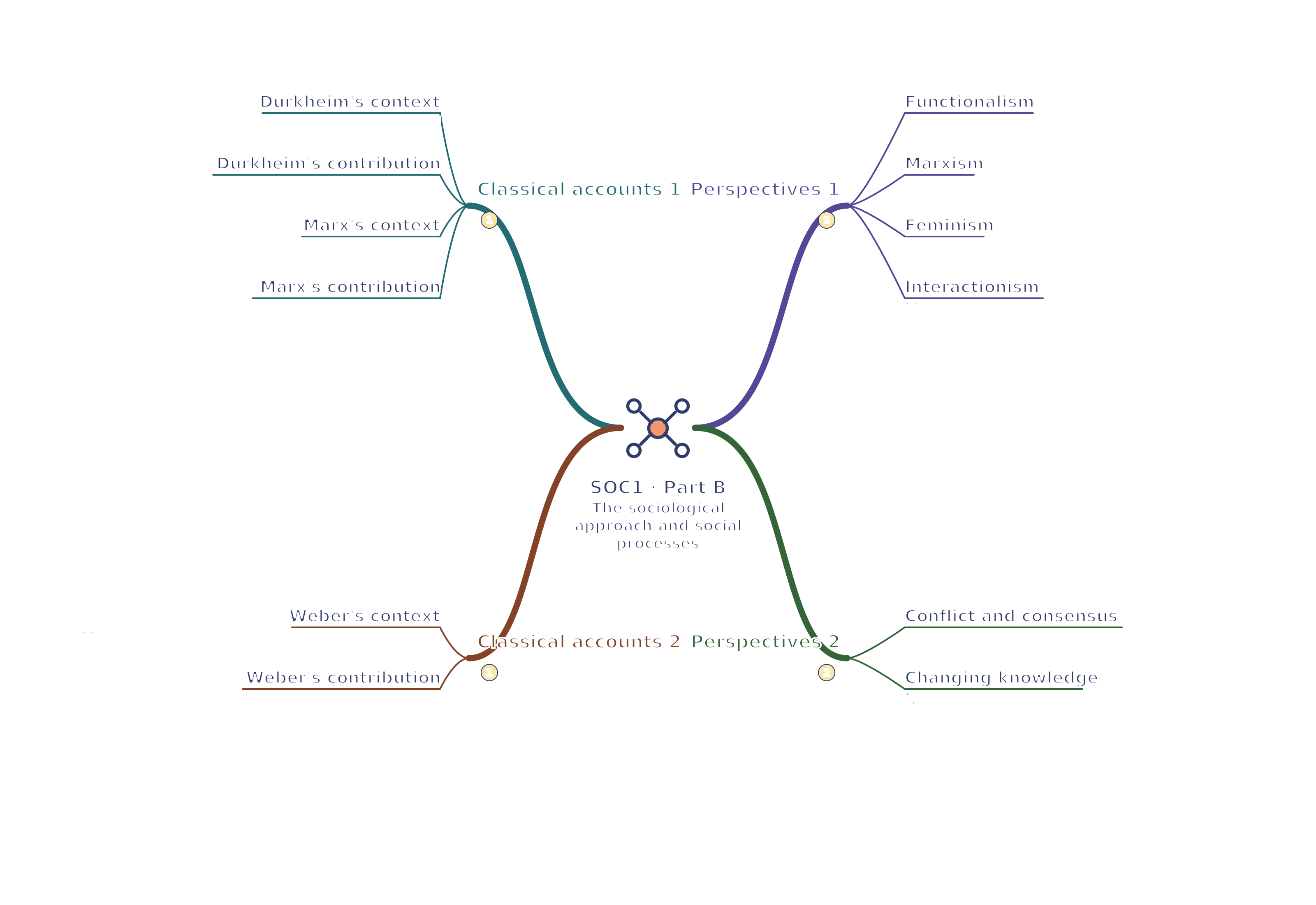
View SOC1 · Classical accounts 1 / Classical accounts 2 / Perspectives 1 / Perspectives 2 mind mapOpen the full-size map to zoom. Download the PDF to print on A4 or enlarge to A3.
Sociological imagination: Connect personal experiences with wider social patterns
Society and institutions: Organised relationships shape opportunities and expectations
Structure and agency: Constraints interact with people's choices
Culture and subculture: Shared meanings vary between and within societies
Society / roles 2
Norms and values: Values express ideals; norms guide behaviour
Roles and status: Expectations attach to positions; status may be earned or assigned
Learning / control 1
Primary socialisation: Early relationships teach language and basic expectations
Secondary socialisation: Schools, peers, media and work extend social learning
Gender socialisation: Expectations can be learned through everyday practices
Social control: Sanctions encourage conformity through formal and informal routes
Learning / control 2
Power and authority: Influence differs from power accepted as legitimate
Labelling and discrimination: Categories can affect treatment and later opportunities
Classical accounts 1
Durkheim's context: Industrial change raised questions about social cohesion
Durkheim's contribution: Social facts and collective norms help explain behaviour
Marx's context: Industrial capitalism organised ownership and wage labour
Marx's contribution: Class interests and exploitation can drive conflict and change
Classical accounts 2
Weber's context: Modern markets and bureaucracy prompted a multidimensional account
Weber's contribution: Class, status and party are distinct sources of advantage
Perspectives 1
Functionalism: Consensus and interdependent institutions sustain order
Marxism: Economic inequality and class conflict organise social life
Feminism: Gendered power and patriarchy require explanation and challenge
Interactionism: Meanings and responses shape action in everyday settings
Perspectives 2
Conflict and consensus: Theories differ over interests, order and change
Changing knowledge: New evidence and social change can revise explanations
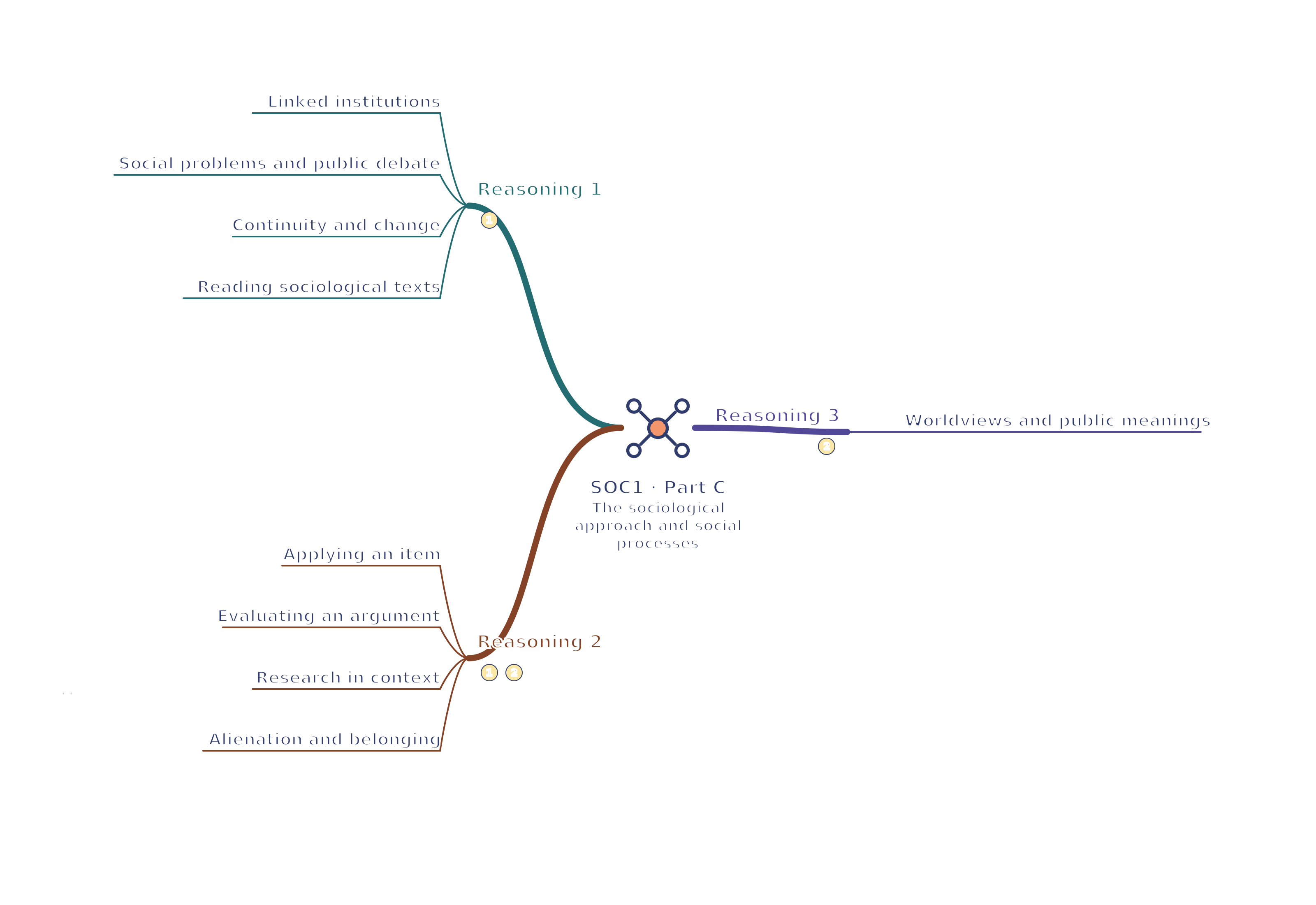
Reasoning 1
Linked institutions: Changes in one area can affect others
Social problems and public debate: Definitions of problems depend on evidence and values
Continuity and change: Compare like measures over specified periods
Reading sociological texts: Identify claim, reasoning, evidence and context
Reasoning 2
Applying an item: Use the specific evidence to develop a sociological explanation
Evaluating an argument: Compare explanatory strengths, limits and alternatives
Research in context: Methods need a fit with people, access and aims
Alienation and belonging: Estrangement from activity differs from cooperative social bonds
Reasoning 3
Worldviews and public meanings: Shared outlooks and stigma influence interpretation and participation
Connections
Society / roles 1 → Learning / control 1: Institutions shape social learning while individuals interpret and respond.
Society / roles 2 → Learning / control 2: Role expectations and labels can be reinforced through sanctions and power.
Part connections
SOC1 · Society / roles 1 / Society / roles 2 / Learning / control 1 / Learning / control 2: Society / roles 1 → Learning / control 1 — Institutions shape social learning while individuals interpret and respond.
SOC1 · Society / roles 1 / Society / roles 2 / Learning / control 1 / Learning / control 2: Society / roles 2 → Learning / control 2 — Role expectations and labels can be reinforced through sanctions and power.
SOC1 · Classical accounts 1 / Classical accounts 2 / Perspectives 1 / Perspectives 2: Classical accounts 1 → Classical accounts 2 — Classical accounts give different explanations of collective bonds and unequal chances.
SOC1 · Classical accounts 1 / Classical accounts 2 / Perspectives 1 / Perspectives 2: Perspectives 1 → Perspectives 2 — Perspectives emphasise different mechanisms and are revised through critique.
SOC1 · Reasoning 1 / Reasoning 2 / Reasoning 3: Reasoning 1 → Reasoning 2 — Applying an item requires evidence-linked reasoning and evaluation of methods.
SOC1 · Reasoning 1 / Reasoning 2 / Reasoning 3: Reasoning 2 → Reasoning 3 — Research and evaluation investigate how belonging, identities and outlooks shape experience.
 Mr Kidman's Classroom