Gametes are sex cells: sperm and egg cells in humans. During fertilisation, their nuclei join (fuse) to form a fertilised egg called a zygote.
Body cells are usually diploid, with two sets of chromosomes. Human diploid body cells have 23 pairs: 46 chromosomes in total.
Gametes are haploid, with one set of chromosomes. Human gametes contain 23 chromosomes.
Meiosis starts with a diploid cell, copies its DNA, and involves two divisions to produce four haploid cells with half the original chromosome number.
The cells produced by meiosis are genetically different. Meiosis and the random combination of gametes at fertilisation contribute to genetic variation.
Fertilisation restores the diploid chromosome number: a human sperm nucleus with 23 chromosomes combines with an egg nucleus with 23 to give a zygote with 46.
Unlike meiosis, mitosis normally produces two genetically identical daughter cells with the same chromosome number as the parent cell. The detailed stages of meiosis are not required for Combined Science.
DNA, chromosomes and genes
DNA is a long molecule (a polymer) made from repeating units called nucleotides. Each nucleotide contains a sugar, a phosphate group and one base.
The four DNA bases are adenine (A), thymine (T), guanine (G) and cytosine (C). Their sequence carries genetic information.
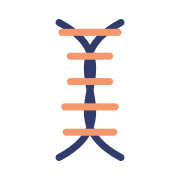
DNA consists of two strands coiled into a double helix. Each strand has a sugar–phosphate backbone.
Bases form complementary pairs between the strands: A pairs with T, and C pairs with G. Weak hydrogen bonds join the paired bases.A pairs with T and C with G. DNA is drawn untwisted to make the pairing clear.
If one strand has the sequence ATGC, the complementary sequence on the other strand is TACG.
Chromosomes contain long DNA molecules. A gene is a section of DNA that codes for a specific protein.
An allele is a version of a gene. Differences between alleles can lead to differences in inherited characteristics.
The genome is the entire DNA of an organism, including DNA that does not form protein-coding genes. It is not just a list of genes.
Extracting DNA from fruit
Crush soft fruit such as strawberry to break up its tissues and increase contact with the extraction solution.
Mix the crushed fruit with detergent and salt solution. Detergent breaks down cell and nuclear membranes, releasing DNA; salt helps the DNA strands collect together.
Filter the mixture to remove solid pieces of cells (cell debris). The liquid that passes through the filter is the filtrate; it contains dissolved DNA and other substances.
Carefully add cold ethanol as a layer above the filtrate. DNA cannot dissolve in cold ethanol (it is insoluble), so it comes out of solution (precipitates) as pale, stringy material where the two layers meet.
The visible strands are many DNA molecules together, not a single double helix. Follow practical safety instructions: ethanol is flammable, avoid ignition sources, and use eye protection.
Genotype, phenotype and alleles
Genotype is the combination of alleles an organism has for a gene or genes. Phenotype is its observable characteristics, influenced by genotype and often the environment.
For a simple inherited characteristic, use a capital letter for the dominant allele and the same lower-case letter for the recessive allele, such as A and a.
An organism is homozygous for a gene when its two alleles are the same: AA or aa. It is heterozygous when they differ: Aa.
In a simple dominant–recessive model, the dominant allele is expressed in the phenotype when one or two copies are present: AA and Aa show the dominant phenotype.
A recessive allele is expressed in this model only when two copies are present: aa. A heterozygous individual can carry and pass on a recessive allele without showing its phenotype.
Dominant does not mean more common, stronger or better. Most human characteristics involve several genes; eye colour is not accurately explained by a single simple dominant–recessive pair.
Punnett squares and probability
A monohybrid cross follows one gene. Write the parents’ genotypes, determine the alleles in their possible gametes, then combine one allele from each parent in a Punnett square.
For Aa × Aa, each parent can produce gametes containing A or a. The four equally likely combinations are AA, Aa, Aa and aa.Each square is an equally likely allele combination, not a guaranteed child.
For Aa × Aa, the genotype ratio is 1 AA : 2 Aa : 1 aa. With complete dominance, the phenotype ratio is 3 dominant : 1 recessive.
The probability of aa in Aa × Aa is 1 out of 4 = 0.25 = 25%. The probability of the dominant phenotype is 3 out of 4 = 75%.
For Aa × aa, half the expected offspring are Aa and half are aa: a 1 : 1 genotype and phenotype ratio in this simple model.
For AA × aa, all expected offspring are Aa and show the dominant phenotype.
Each offspring is a separate chance event. Four offspring do not have to include exactly one recessive individual even when its probability is 25%.
Expected number = probability × total offspring. If a recessive phenotype has probability 0.25, the expected number among 80 offspring is 20; this is an expectation, not a guarantee.
Reading family pedigrees
A pedigree chart tracks a characteristic through a family. Squares usually represent males, circles females; shading indicates who has the characteristic according to the key.
A horizontal line joins parents and a branching line connects them to offspring. Use the key and relationships before assigning possible genotypes.
For an autosomal recessive condition (one carried on a chromosome other than X or Y), affected individuals are aa. An unaffected individual may be AA or Aa. Someone with Aa is a carrier: they can pass on the allele without having the condition.
If two unaffected parents have an affected child with an autosomal recessive condition, both parents must be carriers: Aa × Aa.Two unaffected carriers can have an affected child with an autosomal recessive condition.
An affected aa parent passes a to every child. An unaffected child of that parent must therefore be Aa in the simple recessive model.
Some pedigree evidence leaves more than one possible genotype. Give all possible genotypes when appropriate; do not assign AA to every unaffected individual.
Sex chromosomes
In the usual human XX/XY model, females have XX and males have XY. Sex chromosomes are one pair within the 23 chromosome pairs.
Egg cells carry an X chromosome; sperm cells carry either X or Y. Fertilisation with an X-bearing sperm gives XX, and with a Y-bearing sperm gives XY.
An XX × XY Punnett square gives an approximately 1 : 1 chance of XX or XY offspring. The sperm supplies the chromosome determining the outcome in this model.The standard XX/XY model gives equal expected probabilities of XX and XY offspring.
The outcome of one fertilisation does not change the chance for the next. This model describes the standard GCSE inheritance calculation; biological sex development can be more complex.
Variation and mutations
Variation means differences in characteristics between individuals of the same species. It can have genetic causes, environmental causes, or both.
Genetic variation arises from different alleles. Mutations can create new alleles, while meiosis and fertilisation produce new combinations of existing alleles.
A mutation is a change in DNA. Copying errors can occur when DNA is replicated, and some radiation or chemicals can increase mutation rates.
Most mutations have no effect on phenotype, some have a small effect, and a few have a large effect. A mutation is not automatically harmful or beneficial.
Environmental variation produces acquired characteristics, such as a scar or a change in body mass from diet. Acquired changes do not usually change the alleles passed to offspring.
Many characteristics, such as height, are influenced by multiple genes and the environment, including nutrition.
Continuous variation has a range of values, such as height. Discontinuous variation has distinct categories, such as ABO blood group.
Continuous measurements are often grouped into intervals and displayed in a histogram; distinct categories can be shown in a bar chart. Select a suitable graph for the data.
Some continuous traits show an approximately normal, bell-shaped distribution, with most values near the mean. Not every characteristic or data set follows a normal distribution.
The Human Genome Project
The Human Genome Project determined a reference sequence of the human genome and helped identify genes. It involved DNA from multiple people, rather than mapping only one individual’s genes.
Comparing genomes can help identify gene variants associated with inherited conditions and improve understanding of disease.
Genetic information can help predict some disease risks and guide which medicines may be effective. A risk prediction is not a certainty, especially where many genes and the environment are involved.
Potential benefits include more targeted treatment and improved diagnosis. Decisions about using genetic information also involve privacy, consent and possible discrimination.
Watch CB3 · Genetics · Topic 3 — Genetics
Revise genetics with this narrated video. Use the player controls to pause, seek, adjust the volume or mute. Turn English captions on or off using the captions menu.
 Mr Kidman's Classroom